
Quantcast
Latest Stories

New Internet standard gives global network room to grow
By

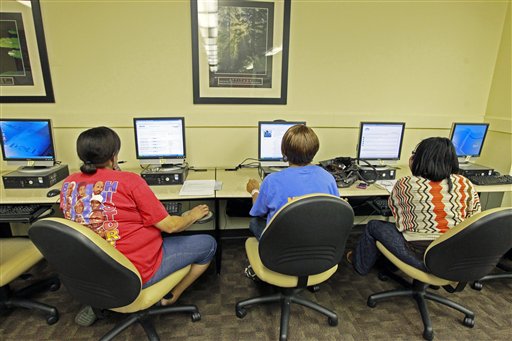
A new standard called IPv6—which came into effect on Wednesday, June 6, 2012, allows for trillions of "IP" numbers or addresses, up from the current 4.3 billion. US equipment maker Cisco is projecting that by 2016, there will be nearly 18.9 billion network connections, or nearly 2.5 connections for each person on earth, compared with 10.3 billion in 2011. AP PHOTO/ROGELIO V. SOLIS

WASHINGTON—A new Internet standard giving the global network more room to grow came into effect Wednesday, a move that users probably won’t notice.

The switch occurred at 0001 GMT Wednesday, when Internet operators switched to a new standard called IPv6 that allows for trillions of “IP” numbers or addresses, up from the current 4.3 billion.

“To ensure the Internet can continue to grow and connect billions more people and devices around the world, thousands of companies and millions of websites have now permanently enabled the next generation of Internet Protocol (IPv6) for their products and services,” the Internet Society, an advisory panel, said.

“Participants in World IPv6 Launch include the four most visited websites in the world – Google, Facebook, YouTube, and Yahoo! – as well as home router manufacturers and Internet Service Providers in more than 100 countries. By making IPv6 the ‘new normal,’ these companies are enabling millions of end users to enjoy its benefits without having to do anything themselves.”

Vint Cerf, one of the inventors of the Internet standard, who is now the “chief Internet evangelist” at Google, said the change gives the Internet room to grow.

“When the Internet launched operationally in 1983, its creators never dreamed that there might be billions of devices and users trying to get online,” he said.

“Yet now, almost three decades later, that same Internet serves nearly 2.5 billion people and 11 billion devices across the globe. And we’re running out of space.”

Some analysts say there may be annoyances for people using older equipment, because the “path” to websites using compatible equipment may be different.

But Johannes Ullrich of the SANS Technology Institute said the transition appeared to be going smoothly.

“So far, there are no big issues with the IPv6 transition,” he told AFP.

He said many Internet operators are using a method known as “Happy Eyeballs,” which allows traffic to be routed over IPv6 or the older IPv4 equipment depending on which is more efficient.

The technology firm Nominum surveyed 67 major Internet service providers in North America, Japan, Europe and Latin America and found that 97 percent of them have either already implemented or plan to implement IPv6.

“European ISPs appear to have the greatest risk of not making the transition in time since under current policies the Regional Internet Registry for Europe is projected to run out of IPv4 addresses later this year,” Nominum said.

The full transition will take several years, and old IPv4 devices and networks should continue to function as before.

Each piece of hardware – including home computers, tablets and mobile devices – has a unique IP address to connect to the Web.

With about seven billion people on the planet, the IPv4 protocol doesn’t allow for everyone to have a gadget with its own online address.

The situation has been equated to not having enough telephone numbers for every user.

If there are not enough addresses, neighbors will have to start sharing IP addresses, which can slow things down.

Over time, home Internet users will need to switch devices such as routers and modems to be compatible with the new system. But Internet service providers have been preparing and say current equipment will function as before.

US equipment maker Cisco is projecting that by 2016, there will be nearly 18.9 billion network connections, or nearly 2.5 connections for each person on earth, compared with 10.3 billion in 2011.

Follow us on Facebook Follow on Twitter Follow on Twitter


Recent Stories:

Cannes: Dern a leading man again in ‘Nebraska’ 1 hour elapsed Seamen may file complaints at sea 2 hours elapsed Rescue of Russian mountaineer from Mt. Mayon proved costly 2 hours elapsed PCG report on grounded US ship due 2 hours elapsed Ninoy Aquino’s birthday is ‘Day of Reading’ 2 hours elapsed Many teachers deputized for poll duty still unpaid 2 hours elapsed CHEd eyes revised college curriculum by 2016 2 hours elapsed Gordon tells Comelec: Don’t remove PCOS 2 hours elapsed
Complete stories on our Digital Edition newsstand for tablets, netbooks and mobile phones; 14-issue free trial. About to step out? Get breaking alerts on your mobile.phone. Text ON INQ BREAKING to 4467, for Globe, Smart and Sun subscribers in the Philippines.

Tags: Internet , IT , US

  • WeAry_Bat

    “Each piece of hardware – including home computers, tablets and mobile devices – has a unique IP address to connect to the Web.”

    False.

    • http://jaoromero.com/ Jao Romero

      yep.

  • raffyb0i

    IPv6 has been around for years, this is not something entirely new. 


Copyright © 2013,
.
To subscribe to the Philippine Daily Inquirer newspaper in the Philippines, call +63 2 896-6000 for Metro Manila and Metro Cebu or email your subscription request here.
Factual errors? Contact the Philippine Daily Inquirer's day desk. Believe this article violates journalistic ethics? Contact the Inquirer's Reader's Advocate. Or write The Readers' Advocate:
c/o Philippine Daily Inquirer Chino Roces Avenue corner Yague and Mascardo Streets, Makati City, Metro Manila, Philippines Or fax nos. +63 2 8974793 to 94
Advertisement

News

  • Many teachers deputized for poll duty still unpaid
  • A double life ends
  • Agnes: Manila paper to cover Gwen notebooks
  • Marina wraps up probe on Yellow Submarine
  • Police to file estafa raps vs suspects
  • Sports

  • Tigers, Falcons score; Blazers stun Tams
  • GM Paragua shares Asian chess top spot with Li
  • Dazed Beermen try to get back at Thais today
  • Sportswatch
  • Catalan, Lim lead Jr Masters champs
  • Lifestyle

  • Ninoy Aquino’s birthday is ‘Day of Reading’
  • You can’t sink in the Dead Sea
  • In New York, Filipino costume and set designer Clint Ramos wins Obie Award
  • Josh Bowman steps into a new role
  • Fashion, fame and Daniel Grayson
  • Entertainment

  • Cannes: Dern a leading man again in ‘Nebraska’
  • Demi Lovato is a work in progress
  • Stars’ ‘shameful’ secrets revealed
  • Penchant for loopy and messy details
  • Nora and Vilma go indie
  • Business

  • Court of Appeals stops field trials of genetically modified eggplant
  • GDP on track to meet 6-7% target
  • Stocks continue to decline
  • BSP chief says capital flight to spare PH
  • Imports contracted in Q1
  • Technology

  • Statement of Smart Communications
  • Yahoo takes big leap with $1.1B deal for Tumblr
  • Poll: More US teens turn to Twitter; Facebook old
  • Tips to avoid becoming an identity theft victim
  • Filipinos in flight want to go online
  • Opinion

  • Brillantes’ tantrums
  • Pointed questions for the Comelec chair
  • Social enterprise as innovative business model
  • Perennial irony
  • Voters like election surveys
  • Global Nation

  • Seamen may file complaints at sea
  • Rescue of Russian mountaineer from Mt. Mayon proved costly
  • PCG report on grounded US ship due
  • Fil-Am staffers and students join UC Medical Center strike frontline
  • Kids make art to help rescue other kids from neglect
  • Marketplace
    Advertisement
    © Copyright 1997-2013 INQUIRER.net | All Rights Reserved