There’s a running joke in the publishing industry that the more tenured you have been with your job, the easier it is for you to identify paper stock by mere touch. Mike Boyle told me his favorites are the Japanese papers. As a fountain pen enthusiast, I could wholeheartedly agree. “Tomoe river paper,” I said, was one of them. “Almost like onion paper but the lifespan of the machines are reaching its end.”
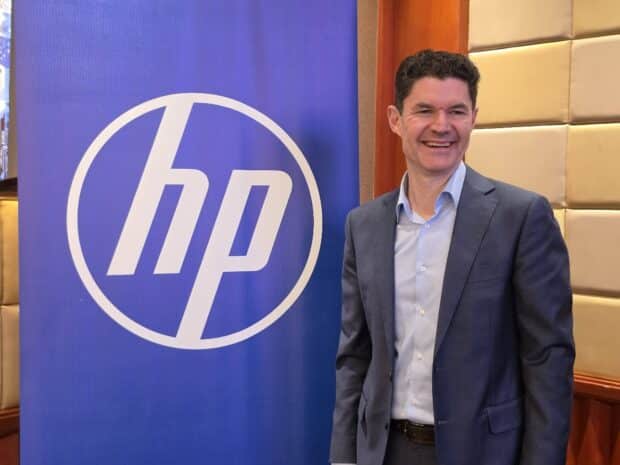
And in a way this set the tone for the discussions that afternoon. Mike Boyle is HP’s newly appointed Managing Director for Greater Asia, and has seen market disruptions, some unprecedented, some current — like the war in Iran and the global supply chain of RAM, so this is not new to him.
AI at the edge, not in the cloud
The conversation kept returning to a single tension: AI is powerful, but trusting it with sensitive data means trusting someone else’s infrastructure. For Boyle, that’s where the real opportunity sits — not in the cloud, but at the device level.
“Cloud does present a risk,” he said, carefully. “For public sector, for enterprise, for personal data.” His point wasn’t to dismiss cloud AI entirely, but to argue that institutions with something to protect — hospitals, government agencies, defense — will increasingly want their AI running locally. On-device. Contained.
There are three reasons he sees this shift accelerating: security first, then speed, then cost. Every query sent to a cloud model is a token spent. As usage scales, so does the bill. Local inference, on the other hand, keeps data in-country and the costs predictable.
For the Philippines specifically, which he called a “fast adoption market,” this isn’t an abstract argument. The appetite is there. The question is whether the infrastructure and the enterprise budget follows. It seems that the train of thought for developing markets is a push towards on-device AI but for that to happen, technology needs new advancements.

Supply chain, tariffs, and the uncomfortable truth about prices
The SSD shortage is real, and Boyle didn’t sidestep it. Global RAM supply constraints, compounded by trade tensions, have already pushed prices up — a trend that started just before the Christmas period and hasn’t fully resolved.
What that means in practice: IDC is projecting a slight dip in overall unit shipments for the second half of the year. Not because demand has collapsed, but because buyers are working with fixed budgets and higher prices force trade-offs.
HP’s answer has been supply chain diversification — manufacturing spread across multiple locations, with a significant concentration now in Southeast Asia. Boyle was careful not to claim full insulation from the problem. “We’re monitoring, as everybody is,” he said of the broader geopolitical picture. No contingency timeline. Business as usual, for now.
What he did point to as a genuine buffer is that Southeast Asia positioning. If the next disruption comes from further upstream, being closer to the end market helps.
What AI is actually doing to print
HP’s large-format business — the industrial side, producing packaging, labels, and wide-format print — has been growing quarter on quarter. AI is showing up there in ways that are less obvious than the usual headline use cases.
One example: digitizing old construction blueprints. Physical plans fed into an AI system, converted into vectorized CAD drawings with indexing. It’s unglamorous work, but the kind that used to eat days of a technical team’s time.
The more interesting example involves Canva. HP has a global partnership with the design platform, where a user who finishes a design and clicks “print” gets routed to a certified HP printer — locally. A user in the Philippines gets their output produced in the Philippines, not shipped from a centralized print facility halfway around the world. The technology is already in-country. The logistics just had to catch up to it.
“The printing is the easy bit,” Boyle said, with the ease of someone who’s watched designers struggle through the upstream process. “AI is speeding up the design, the creative output component.” The bottleneck was never the printer.
The Philippine market, as he sees it
With two days in the Philippines, Boyle was drawing early impressions rather than firm conclusions. What stood out to him: a diversified workforce, a market comfortable with transactional purchasing rather than subscriptions, and a strong uptake of scanning technology in business environments.
On subscriptions — HP runs consumer print subscription models in some markets, but the Philippines isn’t one of them yet. What has gained traction is next-day business support for home printing products. It’s a more practical and simpler market.
Boyle expects 2026 and 2027 to be more decisive years — when edge AI applications become specific enough to drive real demand beyond early adopters and enterprise IT departments.
Until then, he’s watching the same thing everyone else is: whether the use cases catch up to the hardware that’s already out there.