MANILA, Philippines – Filipino scientist Academician Dr. Filemon A. Uriarte Jr. of the National Academy of Science and Technology Philippines (NAST PHL) urged the Philippines during the April 7 Luzon Regional Scientific Meeting to adopt passive cooling in buildings.

The move aims to reduce electricity use and emissions amid rising heat and growing air-conditioning demand through design-based systems that do not rely on mechanical cooling.
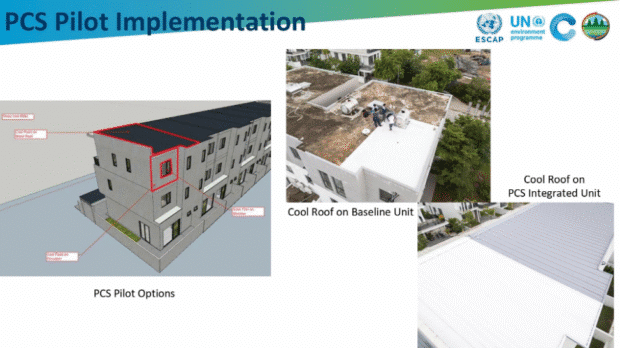
He also proposed the local replication of a United Nations-backed Passive Cooling Strategies (PCS) pilot project previously implemented in Cambodia, which reduces reliance on air-conditioning by improving building design and materials.
Presenting the recommendation at the same meeting, Uriarte said passive cooling could help ease energy demand in tropical countries like the Philippines, especially during hot and dry seasons when electricity consumption peaks.
Cooling demand and emissions reduction potential
In Cambodia, a demonstration project under the United Nations Economic and Social Commission for Asia and the Pacific (UN ESCAP) assessed two residential units, one conventional and one integrated with passive cooling features.
Findings revealed that passive cooling interventions can cut cooling-related emissions by at least 17-percent and reduce electricity consumption for cooling by around 20-percent between 2030 and 2040, compared to a business-as-usual scenario.
Researchers further estimated that scaling the system could avoid nearly 3 million tons of carbon dioxide (CO₂) emissions by 2035, equivalent to emissions from hundreds of thousands of gasoline-powered vehicles.
Uriarte underscored that the results demonstrate strong potential for adaptation in Southeast Asia, including the Philippines, where cooling demand continues to accelerate.
Why the Philippines is a key candidate
The Philippines faces heightened exposure to heat stress due to its tropical climate, fast-paced urbanization, and increasing reliance on air-conditioning systems.
Global energy studies indicate that cooling has become one of the fastest-growing sources of electricity demand, particularly in developing economies.
The International Energy Agency (International Energy Agency) estimates that space cooling already consumes about 10-percent of global electricity, with demand expected to rise significantly as temperatures increase and access to cooling expands.
At the local level, electricity demand in the Philippines often spikes during the dry season, placing pressure on the grid and raising the likelihood of power interruptions in urban centers.
“When we evaluated the project, we said it was successfully implemented. It is effective in as far as the objectives were concerned on reducing energy consumption, and that we recommended to the United Nations that this project be replicated in other areas such as the Philippines and other Southeast Asian countries,” Dr. Uriarte noted.
What passive cooling is
Passive cooling refers to building design strategies that lower indoor temperatures without relying on mechanical air-conditioning systems. Instead of electricity-driven cooling, it leverages natural processes such as convection, radiation, and conduction to regulate heat.
Techniques commonly include reflective roofing, low-emissivity coatings, solar films on windows, shaded structures, and strategic vegetation placement to improve airflow and minimize heat buildup.
Central to the approach is the building envelope, which consists of structural elements like walls, roofs, insulation, and openings that control the transfer of heat, air, and moisture between indoor and outdoor environments.
Uriarte explained that passive cooling relies on context-specific design strategies that limit heat gain through thoughtful planning rather than energy-intensive systems.
He highlighted approaches such as airflow optimization through landscaping, building orientation, and material selection as key components in reducing indoor heat naturally.
The Luzon Regional Scientific Meeting, jointly organized by the National Academy of Science and Technology Philippines and the Department of Science and Technology National Capital Region (DOST), brought together scientists, policymakers, and industry representatives to connect research with sustainability priorities.
DOST Secretary Renato U. Solidum Jr. earlier noted that regional scientific meetings serve as platforms to integrate local research insights into national science and technology planning. (By Rich Longakit, INQUIRER.net Intern)