A short reflection on what drones have become: from weapons of war to content creation tools. In the near future, the marriage of drones and AI assistants will give birth to what we are now referring to as ‘familiars.’ Once confined to the annals of Forgotten Realms and Dungeons & Dragons, familiars are summoned creatures — assistants that help heroes with mundane tasks. A flying, talking drone with a personalized AI can do this. The thumbnail image generated using Nano Banana is an imagining of a pop culture revolution in customization and IP rights.
Remember the time when a drone was a massive, monolithic machine of war? Fast forward to today, and that same technology is a sandwich-sized chunk of silicon and plastic sitting in my backpack, humming with a battery that gets uncomfortably warm against my palm. It’s now.. a toy.
But calling them “flying cameras” misses the point entirely. It’s a fundamental shift in human behavior and how we interact with technology. We are no longer piloting tools. We are in a way, summoning familiars. And I would like to posit this as the future of drones in the next decade. But more on this later.
Let me be brutally honest right out of the gate. If you just want an RC toy to do flips over your neighbor’s pool, the current S-Tier of consumer drones is not for you. Go buy a cheap plastic spinner. The devices hitting the market today—like the DJI Avata 360 and the DJI Neo 2—require a commitment to entirely new workflows. They are data-gathering extensions of your physical senses, and they fundamentally change the habit of how we record our lives.
Fly first, aim later
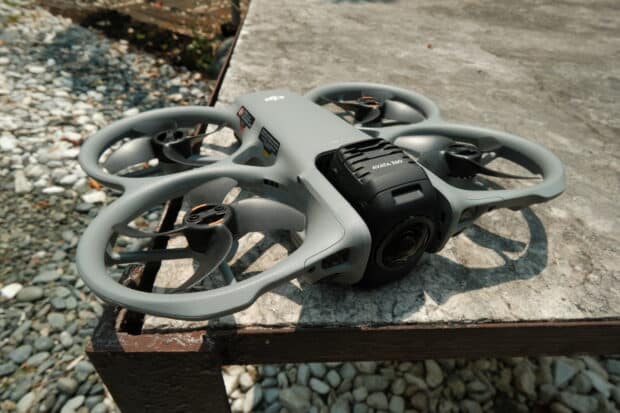
Let’s look at the profound shift happening with the DJI Avata 360. This device slaps dual 360-degree sensors onto a cinewhoop frame, capturing an 8K 60fps sphere of everything around it.

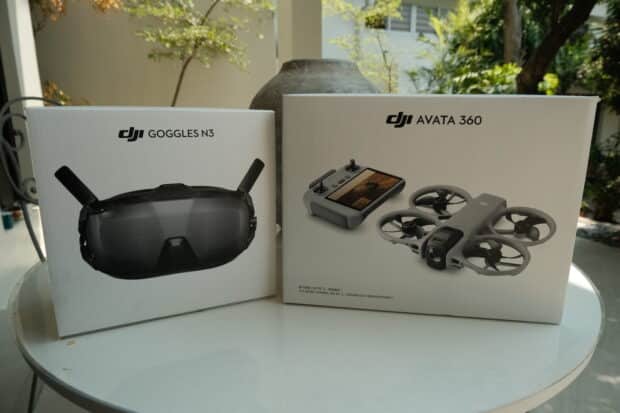
Historically, flying a drone meant sweating bullets as you tried to frame a cinematic pan while desperately dodging tree branches. You were a pilot and a cameraman simultaneously. Now, you are just a director of an omniscient observer. You focus entirely on navigating the environment and making all your framing decisions in post-production. It is the ultimate “aiming in post” workflow.
The engineering marvel of omnidirectional capture comes with physical trade-offs. To fight the wind, these lightweight bodies have to bank and tilt aggressively. Because the drone is shooting in a fixed sphere, your raw footage will occasionally suffer from a jarring “Dutch Angle” as the chassis leans into a sudden gust. Furthermore, while the software frantically stitches the two 180-degree lenses together, sudden directional changes will expose those stitching lines. It’s a visual artifact that breaks immersion.
Thankfully, DJI understands that these things take a beating. They’ve made the lens kits modular and field-repairable, because when you crash—and you will crash—replacing a shattered eye shouldn’t require shipping the entire unit back to a factory.
Bye joysticks?
Then there is the slow, overdue death of the remote control. Other drones like the DJI Neo 2 introduces an interaction model that feels less like operating machinery and more like casting a spell.
Through gesture controls and palm-landing technology, the interface is simply your physical presence. I hold out my empty hand, and the drone lands, the heavy hum of the rotors dying down as the plastic chassis docks onto my skin. There is no fumbling with a plastic joystick, no staring at a phone screen glaring in the afternoon sun. You dictate its position with simple hand signals, commanding automated cinematic maneuvers like a Dolly Zoom without needing a master’s degree in cinematography.
The Neo 2 also quietly murders the micro-SD card by baking in 49GB of internal storage. For anyone who has ever dropped a tiny, fingernail-sized SD card in tall grass during a battery swap, this is a Best in Slot quality-of-life upgrade. It means the drone is always ready to record, completely untethered from physical media management. It removes the friction between wanting to capture a moment and actually capturing it.
Fantasy made real with Familiars
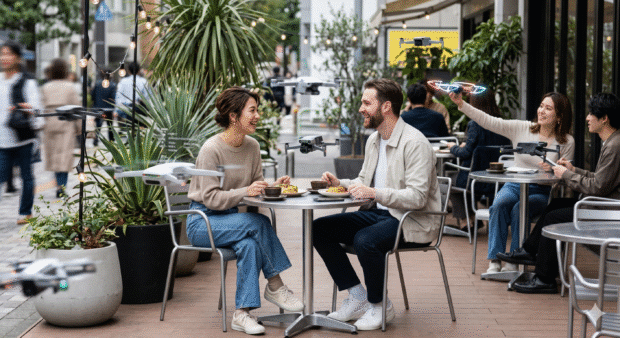
The real endgame, however, is the merger of this physical hardware with AI, creating what I can only describe as a “Tech Familiar.” It’s an assistant that follows you wherever you go.


Press releases love throwing around buzzwords like “neuromorphic AI chips” and “animal-brain logic.” Let’s strip the marketing fluff. What this means in human consequences is a processor that consumes a third of the power while running calculations fast enough to predict your movements so it doesn’t slam into a brick wall.
Let’s go a bit bonkers with the imagination: this creates “Digital Imprinting.” The drone locks onto your heat signature, your gait, and your speed. It transitions from a reactive tool you have to babysit into a predictive NPC companion that follows you autonomously through a crowded street. It’s an active participant in monitoring your personal metrics. Using sentiment analysis, it can detect physical fatigue or stress through your movement patterns, adjusting its distance or proactively offering a safer flight path. It integrates seamlessly into a workflow of self-monitoring, logging how you move through space without you ever having to look at a screen.
As these devices become deeply personal, the ecosystem is shifting heavily into character creation territory. Will your drone act as a stoic guardian or a playful assistant? By adding 3D-printed modular skins to the hardware and loading specific “skills” onto the software layer, you are essentially customizing a companion’s Skill Tree for your specific needs—whether that’s mapping a hiking trail or acting as an air-quality monitor for your immediate vicinity. I’m reminded of a book I read titled DAEMON by Daniel Suarez in 2006. It envisions global warfare but gamified into an augmented reality HUD where soldiers are “players” — ordinary civilians that can unlock skills through a global network of hardware glasses (they essentially predicted Meta Ray Bans) and drones.
The verdict

The question you have to ask yourself isn’t what drone you want to buy, but what kind of relationship you want with your technology. If you are willing to trade the tactile, manual control of a joystick for the predictive autonomy of a digital companion, the future seems to be closer that we think.