
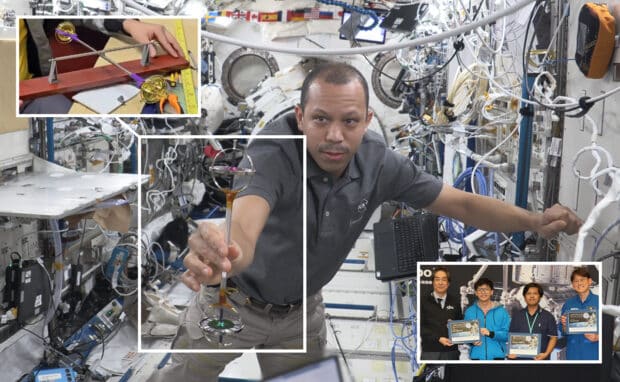
A microgravity experiment designed by Filipino students to study the behavior of spinning gyroscopes in space has been carried out aboard the International Space Station (ISS) as part of the 2025 Asian Try Zero-G (ATZG 2025) competition organized by the Japan Aerospace Exploration Agency (JAXA).
According to the Philippine Space Agency (PhilSA), the experiment demonstrates a principle used in spacecraft orientation—how satellites and spacecraft maintain or control the direction they face in space.
PhilSA said NASA astronaut Christopher Williams conducted the “Double Gyroscope” experiment inside the Kibo module of the ISS on March 24.
The experiment was developed by third-year Rizal Technological University (RTU) astronomy students majoring in astrophysics: Christopher Tumamac, Ryan Andrew Doña and Rose Ann Cezar. Their proposal was selected alongside 10 other finalists from Australia, Bangladesh, Japan, Malaysia, Singapore, Taiwan, Thailand and the United Arab Emirates.
Williams conducted the 11 finalist experiments aboard the ISS while participants watched through a live stream at the JAXA Tsukuba Space Center in Ibaraki, Japan.
In an introduction video released by JAXA ahead of the live demonstration, the students described the Double Gyroscope as an experiment “consisting of two gyroscopes mounted at both ends of a stick,” with the rotors responding simultaneously to tangential forces applied at both ends.

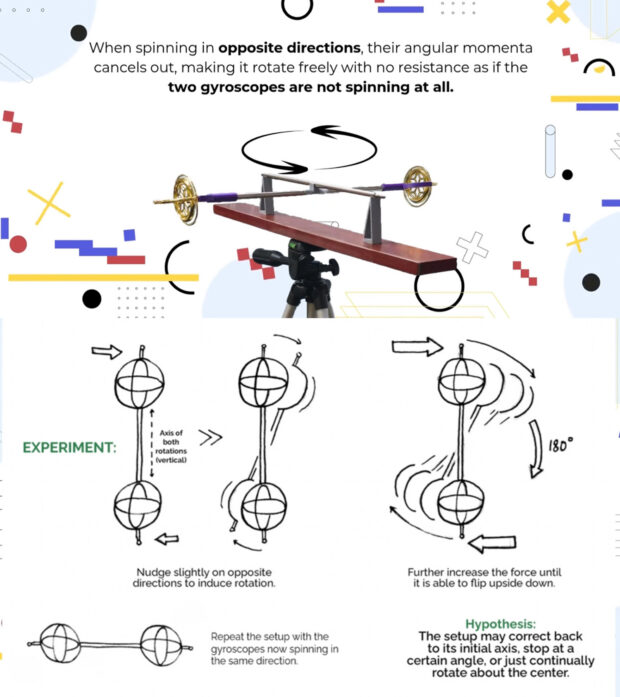
Christopher Tumamac, Ryan Andrew Doña, and Rose Ann Cezar of Rizal Technological University explain the concept behind their “Double Gyroscope” experiment in an introduction video released ahead of the 2025 Asian Try Zero-G competition. Screenshot from JAXA YouTube video
The group added that they hypothesized the system would “exhibit precession at a certain angle” when both rotors spin in the same direction, while opposite spins would allow the setup to “rotate freely with little to no resistance.”
The students also said they joined the competition to challenge themselves as a team and expressed hope that the experiment could inspire future space enthusiasts across the Asia-Pacific region.
Studying gyroscope motion in microgravity
PhilSA said the Double Gyroscope experiment demonstrates a principle used in spacecraft orientation, particularly how satellites and spacecraft maintain or control the direction they face in space.
The agency said the experiment focused on two gyroscopes placed at opposite ends of a stick to observe how spinning motion behaves under microgravity conditions.
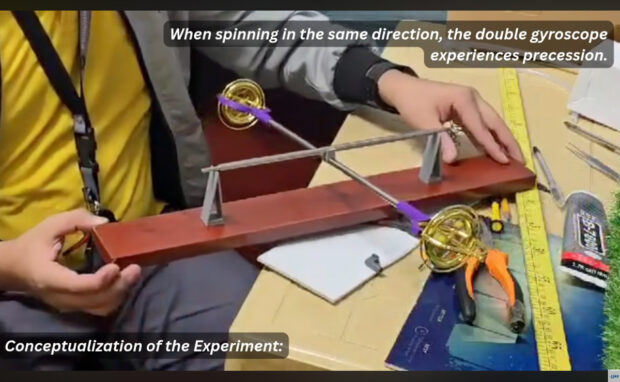
Christopher Tumamac, Ryan Andrew Doña, and Rose Ann Cezar of Rizal Technological University explain the concept behind their “Double Gyroscope” experiment in an introduction video released ahead of the 2025 Asian Try Zero-G competition. Screenshot from JAXA YouTube video
“The students hypothesized that when the gyroscopes spin in opposite directions, their motion may cancel each other out, causing the system to appear stable or nearly motionless. However, small differences in spinning could slowly change the direction the device points to over time,” PhilSA said.
To observe the movement in zero gravity, Williams repeatedly conducted tests by spinning the gyroscopes while closely monitoring the system’s movement aboard the ISS.
PhilSA said the results of the experiments, including the competition winners, will be presented during the 2025 ATZG wrap-up session later this year.
Philippine participation in ATZG
The Philippines has participated in the ATZG competition through PhilSA, which serves as the local organizer as part of its education and outreach initiatives.
Since 2022, Filipino student experiments have consistently been selected as ATZG finalists and later conducted aboard the ISS by astronauts.
These included studies on the rotation of dumbbell-shaped objects in space by William Kevin Abran; “Oloid’s Movement in Microgravity” by Paul Anton Mahinay; and “The Effectivity of Elastic Resistance Band Exercise when performed in Zero-Gravity” by Gabriel John Guila, Dianne Cristine Cabiedes, Sean Matthew Castaneda, Franz Joshua Corpuz, Jose Ernest Guila, Arniel Kurt Macalla, Lee Andrew Medina, Giorgione Parrera and Ace Gabriel Pega.
READ: This UP student’s microgravity experiment was conducted on the Int’l Space Station
PhilSA said the Double Gyroscope experiment was selected from 89 proposals submitted nationwide from Nov. 15, 2024, to Jan. 17, 2025, before advancing as one of the Philippines’ official entries to ATZG 2025 and later being chosen by JAXA.
Presentation at Tsukuba Space Center
Team members Doña and Tumamac also presented their experiment proposal at the JAXA Tsukuba Space Center before the live execution aboard the ISS.
PhilSA said the observed results during the ISS demonstration aligned with the hypotheses outlined in the students’ study.
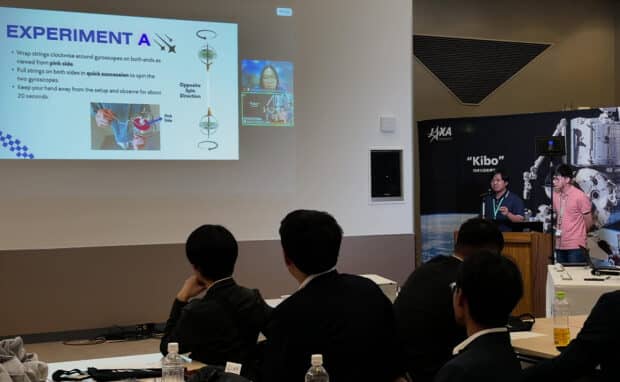
Facing the photo: (L) Christopher Tumamac and (R) Ryan Andrew Doña present their experiment proposal at the Tsukuba Space Center, Japan. Photo courtesy of Philippine Space Agency.
JAXA Kibo Utilization Center director Dr. Masaki Shirakawa and JAXA astronaut Norishige Kanai later awarded certificates of recognition to the finalists during the event.
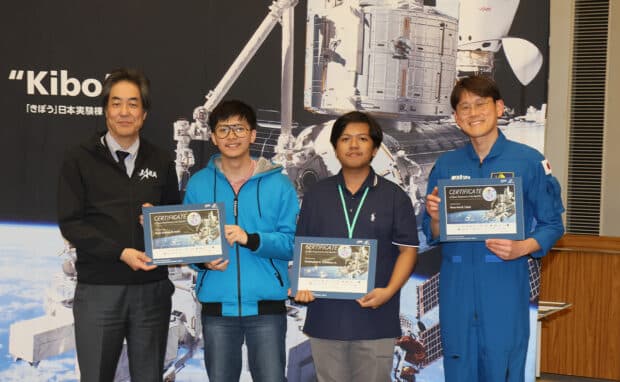
JAXA Kibo Utilization Center Director Dr. Masaki Shirakawa (left-most) and JAXA astronaut Norishige Kannai (second-to-the-right) present Team Double Gyroscope with their certificates as ATZG2025 finalists. Photo courtesy of JAXA/NASA.
Reflecting on the experience, the Philippine team said conducting experiments in a zero-gravity environment presented “unique challenges and opportunities,” noting that weightlessness can affect how objects move, even with careful planning.
“We are very thankful for this opportunity given to us by PhilSA and I hope in the next batches of ATZG, more Filipino students will apply so they can also experience proposing an experiment in zero-gravity, see their experiment carried out, and learn a lot,” the team said.
Regional space science initiative
The Asian Try Zero-G competition is part of the Kibo-ABC program, or Asian Beneficial Collaboration through Kibo Utilization, established by the Space Frontier Working Group of the Asia-Pacific Regional Space Agency Forum (APRSAF).
The program promotes the use of the Japanese Experiment Module “Kibo,” strengthens the capabilities of participating organizations and encourages collaboration among member countries.
PhilSA said the competition also aims to expand the use of the Kibo module aboard the ISS while developing young people’s understanding of space environments. /dm