
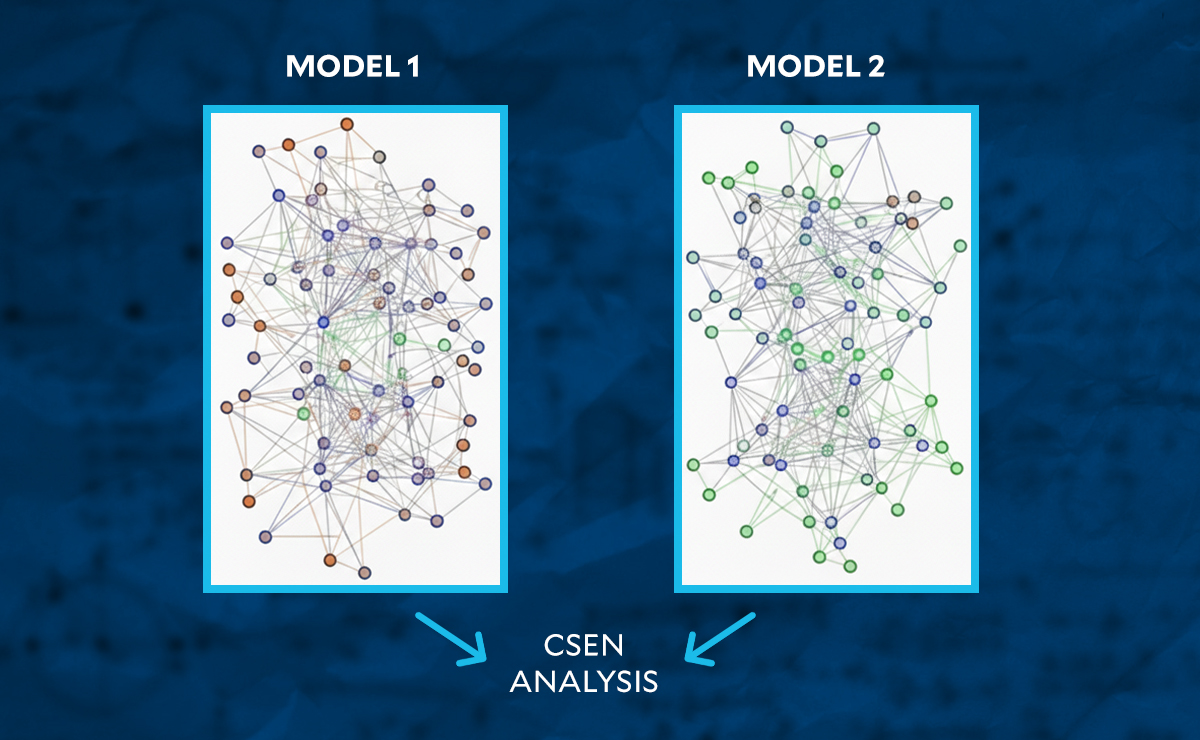
MANILA, Philippines — Scientists often rely on mathematical models to understand how diseases develop and how biological systems function. But when different research groups build models for the same process, comparing them can be difficult, leaving unanswered questions about which findings are truly consistent across studies.
A team of Filipino mathematicians has developed a new method that could help address that problem.
Researchers from the University of the Philippines Diliman College of Science Institute of Mathematics (UPD-CS IM) and De La Salle University introduced Common Species Embedded Networks (CSEN) analysis, a mathematical approach for comparing reaction networks more effectively and uncovering connections that may not be immediately visible.
The researchers said the method could help scientists refine biological models and identify more reliable targets for future drug research.
The study was led by Bryan Hernandez of UPD-CS IM, together with Patrick Vincent Lubenia and Eduardo Mendoza of the Center for Natural Science and Environmental Research of De La Salle University.
Comparing different views
Reaction networks are mathematical representations of how substances such as proteins, molecules and chemicals interact within a biological system. They form the foundation of many models used in systems biology and are often used even when detailed experimental data are unavailable.One challenge, however, is that researchers frequently develop different reaction networks to describe the same biological process.
“In the field of systems biology, different researchers often propose different reaction networks to describe the same biological process. Historically, it has also been difficult to compare these models because they are often treated as entirely separate entities, utilizing different sets of variables and reactions,” Hernandez said.
To address this, the researchers developed CSEN analysis, a method that focuses on the species shared by different reaction networks and examines how those networks relate to one another.
“The method works by first isolating the networks ‘embedded’ within the models that involve only the common species. For the reactions that are not identical, the method checks for ‘transformations’ — mathematical links that can explain how one reaction set might induce equivalence between the systems with the underlying embedded networks,” Hernandez said.
Testing the method
The team demonstrated the method using the Wnt signaling pathway, an important biological system involved in embryonic development, cell communication and tissue maintenance.
Over the years, scientists have proposed several mathematical models of Wnt signaling. Although these models aim to describe the same biological process, they often differ in structure, making direct comparisons difficult.
Using CSEN analysis, the researchers examined several established Wnt signaling models developed by Lee, Schmitz, MacLean and Feinberg.
Their findings showed that some models previously considered distinct were more closely related than expected. In several cases, reaction networks that appeared different were found to share structural similarities through specific mathematical transformations.
The method also helped identify cases where no such relationship existed.
According to the researchers, this provides a clearer picture of how different models relate to one another and can reveal connections that traditional comparison methods may overlook.
Looking beyond stability
The approach combines two key ideas. The first is network embedding, which simplifies a complex reaction network by focusing only on species shared across models.
The second is structural comparison, which examines whether different models are related by mathematical transformations or whether one model represents a more detailed version of another.
“Traditional approaches often discriminate between models based on specific properties, such as whether they have one long-term state (mono-stationarity) or the capacity for multiple long-term states (multi-stationarity). CSEN is different because it looks at the underlying structure and dynamical equivalence,” Hernandez said.
For the Wnt signaling models, the analysis produced an interesting result. Some models long considered fundamentally different because of their stability properties turned out to have underlying structural similarities.
The finding suggests that models can sometimes be more closely connected than previously believed, even when they appear different on the surface.
Potential applications
While the researchers demonstrated the method using Wnt signaling, they said its potential applications extend far beyond a single biological pathway.
“While we demonstrated its use with Wnt signaling, it can be applied to any system represented by reaction networks. This includes other biological pathways, such as insulin signaling or metabolism, as well as potentially non-biological networks such as chemical engineering processes or ecological models,” Hernandez said.
The researchers noted that CSEN analysis could help scientists refine existing models by identifying which components are unique and which may be redundant.
It may also support efforts to identify promising therapeutic targets.
If multiple models consistently identify the same interaction as an important driver of a disease, despite differences in their overall structures, researchers may have greater confidence that the interaction warrants further investigation as a potential drug target.
The study, titled “Embedding-based comparison of reaction networks of Wnt signaling,” was published in MATCH Communications in Mathematical and in Computer Chemistry, an open-access journal that publishes original research and reviews on mathematical methods and their applications to chemical problems.
For the researchers, the work offers a new way to compare biological models that have traditionally been examined separately, potentially helping scientists better understand complex systems and make stronger use of the growing number of models available across the life sciences. /dm
RELATED STORIES
NASA astronaut performs Filipino students’ space experiment
UP chemists develop AI tool to help fight antimicrobial resistance
UPOU study: Wild plants may help disaster-hit communities survive