


The Acer Predator Atlas 7 fits an Intel Arc G3 inside your pocket


I have spent enough time looking at many different gaming handhelds through the years to know that most of them eventually start blending together. The Predator Atlas 7 did not and everyone present at Acer’s reveal of the Predator Atlas 7 at IFA 2026 was thoroughly intrigued.
Acer’s new handheld immediately caught my attention because of what it is trying to fit into a device that is small enough to carry around. It has a seven-inch 1080p display running at 120Hz, Intel’s new Arc G-Series hardware, up to 24GB of LPDDR5x memory, up to 1TB of PCIe Gen4 storage and an 80Wh battery option. It runs Windows 11 Home, so it is essentially a small PC that happens to have built-in controls.
I do not need another device that exists solely to sit on a desk. If I am going to add another piece of hardware to the bag I already carry around, I want it to give me a reason to bring it. The Atlas 7 looks like it could.
The obvious use case is gaming while travelling. That isn’t exactly the most thought-provoking selling point today until you consider what Acer has put into the machine. The larger battery configuration is rated at 80Wh, while the device remains under 750 grams. The smaller 60Wh configuration weighs under 700 grams. Acer has also included two Thunderbolt 4 ports, a UHS-II microSD card reader, a 3.5mm audio jack, Wi-Fi 7 and Bluetooth 5.4.
The screen gives you absolute cinema on the go
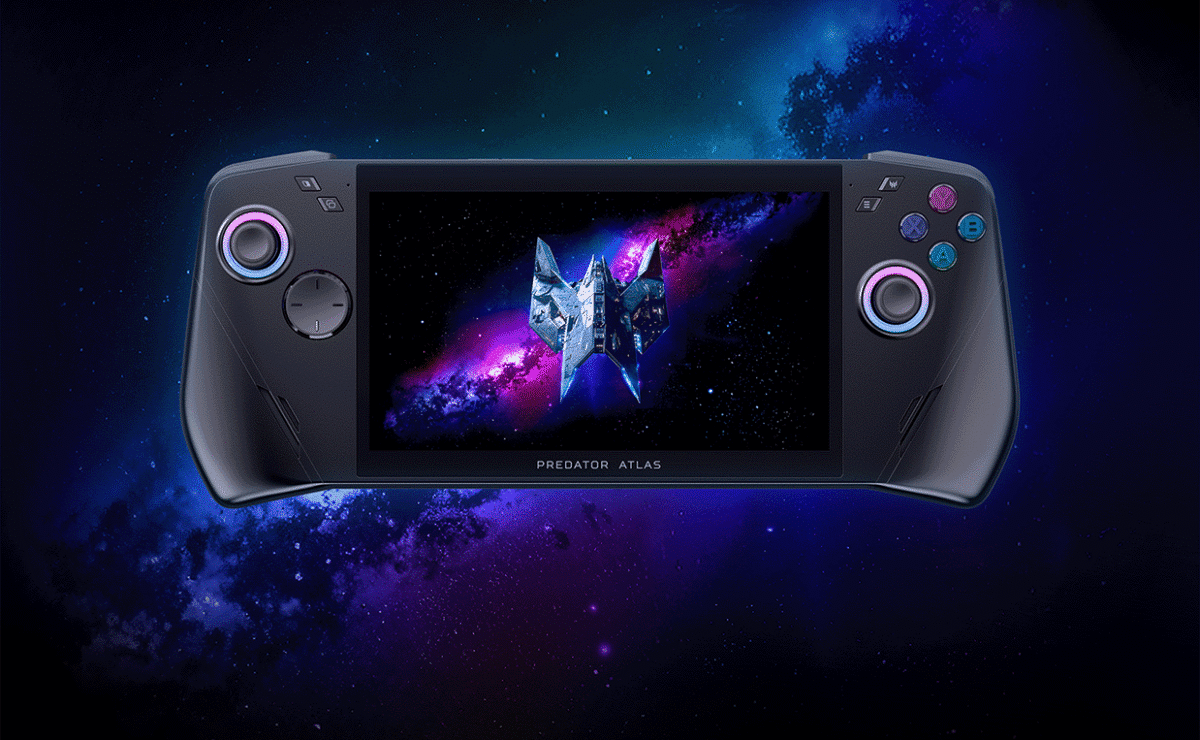
The seven-inch display is 1920 x 1080, supports a 120Hz refresh rate and Variable Refresh Rate, and reaches up to 500 nits. Acer also says it covers 100% of the sRGB color gamut and uses Gorilla Glass Victus with a DXC surface treatment.
There is nothing particularly exotic about those numbers individually. Put together, however, they describe the kind of display I would want on a handheld that is going to be used in places other than my room.
A 1080p resolution is sensible at this size. The 120Hz refresh rate gives games room to feel responsive, while VRR should help when frame rates move around. The 500-nit brightness is also useful for a machine that is supposed to leave the house, although actual outdoor visibility will depend on the conditions.
Small but crazy power
The Atlas 7 is built around Intel’s Arc G-Series platform. The top configuration uses an Intel Arc G3 Extreme processor paired with Intel Arc B390 graphics, with up to 24GB of LPDDR5x memory and 1TB of PCIe Gen4 NVMe storage.
Acer is also building support for XeSS 3, including AI-powered upscaling and multi-frame generation in games that support the technology.
PC hardware has always involved compromises when you shrink it down. A desktop has space for cooling and power delivery. A gaming laptop has more room than a handheld. A handheld has neither luxury. Every component has to justify its place inside a much smaller chassis.
It uses a dual-fan cooling system, including one of Acer’s 89-blade AeroBlade metal fans, alongside its Vortex Flow design. Acer says the AeroBlade design increases airflow by more than 10%.
The specifications are promising. The real test will be what happens when someone actually plays demanding games on it for an extended period.
That is something I would very much like to find out for myself. If I can be blessed to get my hands on it for a longer period of time because the Atlas 7 is not yet available to the media and the public.
Acer has also given the handheld contoured grips, a larger palm-rest area, recessed keys and an anti-slip texture. Certain configurations use TMR joysticks, while the triggers use Hall-effect technology. There are also programmable rear macro buttons.
It’s lightweight but with a focus on good ergonomic control designed to be used for hours. Acer understood that if you want to game you want to do it for hours and I’m all for it.
There is even a fingerprint sensor built into the power button for Windows Hello. It is a small addition, but it makes sense on a Windows machine that is supposed to be used away from home.
A lot less bulk than your gaming laptop
The idea of having my PC games with me without having to bring my gaming laptop is not the newest proposition but the Atlas 7 is making it seem revolutionary but remember this bad boy weighs under 750 grams.
There are plenty of situations where I could see the Atlas 7 making sense. A long trip. An airport. A hotel room. A few hours between appointments. A day when I know I will be away from my set up.
The fact that it is a Windows machine makes that possibility more interesting. I would not have to think of it purely as a console. It can access PC games and launchers, and its Thunderbolt 4 ports mean it can also connect to displays, docks and other accessories when it is being used in a more permanent setup.
I have never really wanted a handheld just because it was smaller. I want one because it changes where I can use my unhealthily large Steam library and Xbox game pass on the go.
Acer unveiled the Predator Atlas 7 ahead of IFA 2026, but it is not available to buy yet. The company says it will launch in North America in the fourth quarter of 2026 and in Europe, the Middle East and Africa in November. Acer has not announced pricing or Philippine availability.
So I am left looking at a product that I already know exactly where I would put it and exactly when I would probably use it, without actually being able to buy it. There were a lot of people around ogling the unit as well so I couldn’t hog it less bring it home with me. But, boy, did I want to.
There is still a lot we do not know. Actual battery life will depend on how the machine is configured and what it is running. Performance will vary from game to game. Pricing could completely change how attractive the device is. My contact from Acer said it definitely won’t be cheaper than a Steam Deck.
For now, though, the Predator Atlas 7 occupies an irritating position in my head. It is one of those gadgets that makes sense on paper, fits the way I would actually use it and has enough unusual hardware to make me genuinely curious about what Intel’s new platform can do.
Acer also teased the Dual Play Mini at IFA 2026 which comes with a built-in keyboard but that’s quite a way off. Being able to play FPS games with a keyboard on the go minus the bulk of a laptop is a terribly enticing prospect.


