





Internet group picks little-known executive as CEO


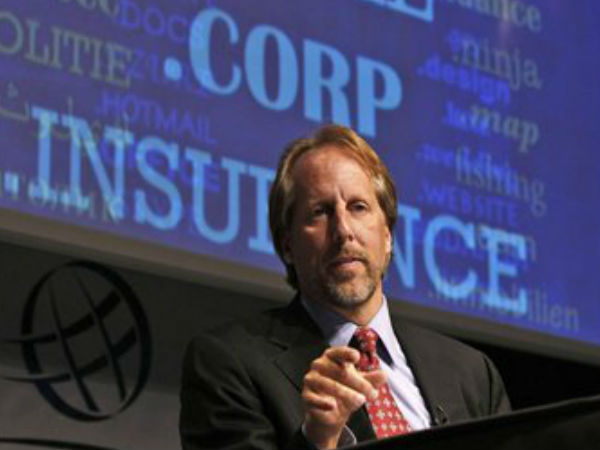
Internet Corporation for Assigned Names and Numbers, ICANN former Chief Executive Rod Beckstrom. (Tim Hales/AP Photos)
NEW YORK — A businessman with experience in building consensus will be the next CEO of the Internet agency in charge of contentious policies surrounding Internet addresses.
The Internet Corporation for Assigned Names and Numbers, which is pushing through a major change in the way Web and email addresses are structured and assigned, announced Fadi Chehade’s appointment Friday. He will replace former U.S. cybersecurity chief Rod Beckstrom as chief executive.
In selecting Chehade, ICANN went with someone who isn’t well known and isn’t well versed in the organization’s core tasks — keeping the Internet address system running smoothly.
Chehade does, however, have a knack for diplomacy. In the early days of e-commerce, he persuaded leading tech companies such as IBM and Hewlett-Packard to collaborate on a system called RosettaNet for exchanging data, even as they competed for customers. ICANN Chairman Steve Crocker said those achievements outweighed the drawbacks.
In an exclusive interview with The Associated Press ahead of the announcement, Chehade, 50, said his work at RosettaNet prepared him for the new role.
“The thrill and the satisfaction of bringing people around some common understanding is tremendous,” Chehade said. “I have a personal and deep love of bringing consensus.”
He said that when executive recruiters contacted him about the position at ICANN, “I immediately had flashbacks of how much I enjoyed doing a job that everybody told me was impossible and difficult.”
As CEO, Chehade will receive a base salary of $560,000 plus up to $240,000 in bonuses based on merit. He is tentatively set to start Oct. 1. His tenure lasts until July 1, 2015.
Beckstrom leaves ICANN this July 1. Chief Operating Officer Akram Atallah will serve as CEO in the interim.
One of Chehade’s chief tasks will be guiding the largest expansion of the Internet address system since its creation in the 1980s. The change affects how people find Web sites or send email and could lead to more options for businesses as easy-to-remember “.com” names are harder to obtain.
ICANN has received 1,930 proposals for 1,409 different domain name suffixes, including “.love,” ”.google” and “.music.” They would rival “.com” and others now in use. A florist called Apple can’t use “apple.com” today because the computer company has it, but the shop might get “apple.flowers” one day.
Even after a decade of debate, however, the expansion still faces criticism, much of it from trademark holders who worry about having to police the Internet for addresses that misuse their brands.
“Anything new like this is going to create angst and controversy, and it’s going to create opportunity,” Chehade said.
ICANN is also in charge of assigning the numeric Internet Protocol addresses used to identify computers, smartphones and other Internet-connected devices. And it faces perennial calls for the United Nations to take a greater role in crafting Internet policies. Although ICANN has board members from around the world, it is headquartered in Los Angeles and gets its authority from the U.S. government, which funded much of the Internet’s early development.
Chehade has some international experience, having served for a year in Dubai as IBM general manager for global technology services for the Middle East and North Africa. Born in Lebanon and of Egyptian decent, he speaks English, Arabic, French and Italian. He lives in Los Angeles and became a U.S. citizen in 1986.
Chehade moved to the U.S. in 1980 at age 18. Smuggled out of Beirut, he arrived in Los Angeles with $482 and worked two restaurant jobs there before attending Polytechnic Institute of New York on a scholarship. After graduating with a computer science degree in 1985, he got a master’s in engineering management from Stanford University a year later.
He worked at Bell Labs before starting a company, Nett Information Products, in the early 1990s. The company offered services that used Lotus Notes software to let companies collaborate with partners over proprietary networks. Ingram Micro Inc., a distributor of information-technology products, bought the company in 1996 and tasked Chehade with adapting the services to run over the Internet.
It was there that he built software for computers from various companies to talk to one another with little human intervention. For instance, when CompUSA places an order through 3Com Corp.’s website, 3Com’s computers automatically contact Ingram Micro’s machines to ship the products to CompUSA.
That system was custom built. Its success prompted Chehade to create standards — such as common ways for proprietary systems to define shopping baskets — so that it could be used by hundreds or thousands of businesses.
That effort evolved into RosettaNet, which brought together leading, sometimes-competing companies such as Microsoft Corp., SAP AG, Oracle Corp., IBM Corp., Hewlett-Packard Co., Dell Inc. and Cisco Systems Inc., along with FedEx and UPS.
“I had to get all these Silicon Valley giants in a room and convince them that if their machines talk to each other, we don’t lose a competitive advantage,” Chehade said.
After leaving RosettaNet in 2000, Chehade created Viacore Inc., which offered supply-chain management services to businesses that didn’t want to build their own systems in-house. IBM bought the company in 2006 and hired Chehade. He left IBM in 2009, after spending a year in Dubai. After a brief stint as CEO of CoreObjects Software Inc., Chehade became head of Vocado LLC, which makes software for educational institutions.
Atallah, the No. 2 executive at ICANN, was Chehade’s deputy at CoreObjects. They had also known each other as children; both served in the boy scouts in Lebanon.
Chehade credited the Internet with helping him stay in touch with childhood friends, many of whom scattered around the world because of a lengthy civil war in Lebanon during the late 70s and 80s. He said his “personal and professional passion about the value of the Internet” will lead him to favor policies that keep the Internet free from unnecessary restrictions.
At a news conference in Prague announcing his appointment, Chehade added, “I’m here because I owe the Internet everything that I’ve achieved today.”


