





Apple jurors grappled with complex patent issues
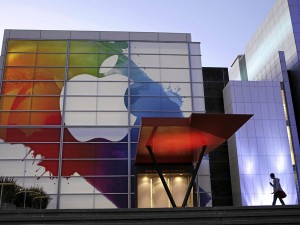
An Apple logo is seen at the entrance of Yerba Buena Center for Arts in this March 6, 2012 file photo in San Francisco. AFP FILE PHOTO
SAN JOSE, California – The youngest juror, a 24-year-old whose favorite court attire was T-shirts bearing the names of rock bands, chose a Beatles sweatshirt for Friday’s dramatic unveiling of the $1.05 billion verdict in favor of computer titan Apple Inc.
One of the oldest was a retired electrical engineer who, as foreman, signed the unanimous verdict that South Korea’s Samsung Electronics Co. copied Apple’s patented technology for the iPhone and iPad. Among the other seven jurors were a homemaker, a bicycle shop manager and a U.S. Navy veteran.
The decision Friday by this panel of people from many walks of Silicon Valley life was one that experts say could dramatically alter the future of computer tablet and phone design if the verdict stands. But the case also is part of a trend that has accompanied an explosion in the number of patent infringement cases, especially in the technology sector.
Increasingly, these highly complex disputes are being decided by juries, rather than judges, and the juries tend to issue more generous awards for patent violations.
That has companies on the receiving end of successful patent infringement lawsuits crying foul and calling for reform in the patent system, but it also has some legal experts questioning whether ordinary citizens should be rendering verdicts and fixing damages in such high-stakes, highly technical cases.
“That’s a great question … and it’s the subject of a fair amount of current debate,” said Notre Dame University law professor Mark McKenna.
Deliberations in the Apple v. Samsung battle were far more challenging than most. The jury was confronted with hundreds of questions on a 20-page verdict form that was more complicated than a U.S. tax return. They had in the jury room more than two dozen electronic devices at issue, 12 patents to decipher and 109-pages of instructions from the judge on rendering a verdict.
“This case is unmanageable for a jury,” Robin Feldman, an intellectual property professor at the University of California Hastings Law School, said before the verdict. “There are more than 100 pages of jury instructions. I don’t give that much reading to my law students. They can’t possible digest it.”
“The trial is evidence of a patent system that is out of control,” Feldman said. “No matter what happens in this trial, I think people will need to step back and ask whether we’ve gone too far in the intellectual property system.”
Apple filed suit in April 2011, accusing Samsung of essentially selling illegal knockoffs of its popular iPhones and iPads. Apple demanded $2.5 billion in damages and an order barring U.S. sales of the Samsung products in question. Samsung countered with its own claims, accusing Apple of using wireless technology it owned.
The jury rejected Samsung’s claims and refused to award Apple the maximum amount demanded, finding that fewer Samsung products violated Apple’s patent than alleged.
The jury arrived at its verdict after less than three days of deliberations, far swifter than many experts thought in view of the many complex issues.
The foreman, Velvin Hogan, a 67-year-old electrical engineer, told the San Jose Mercury News on Saturday that the panel was methodical. “We didn’t whiz through this,” said Hogan, who relied on his own experience patenting inventions. “We took it very seriously.”
Hogan, who does not own Apple products, said the first task was to determine if Apple’s patents were valid. Using his own experience getting a patent, Hogan said he had a revelation on first night of deliberations while watching television. “I was thinking about the patents, and thought, ‘If this were my patent, could I defend it?'” Hogan recalled. “Once I answered that question as yes, it changed how I looked at things.”
The jury did not completely grant Apple’s demand for at least $2.5 billion, Hogan said, but they “wanted to send a message to the industry at large that patent infringing is not the right thing to do, not just Samsung.”
Although the jurors all promised to weigh the evidence fairly, jury consultant Ellen Brickman said Samsung started out the underdog for several reasons. Apple is based just 10 miles (16 kilometers) from the courthouse, jurors have a predisposition to side with patent holders, and Samsung is a foreign-based company fighting a domestic outfit during tough economic times.
Finally, she noted that many Americans view Apple and its late founder Steve Jobs as legendary innovators. “Apple changed the world when it came to computers. Apple changed the world when it came to phones,” she said.
Samsung has vowed to fight the case all the way to the U.S. Supreme Court. It will first ask the trial judge to toss the verdict. Failing that, Samsung will appeal to the Court of Appeals for the Federal Circuit in Washington D.C., a specialized court that hears nearly all patent appeals.
Apple itself benefited from a judge last year reversing a jury’s verdict in a patent trial in Tyler, Texas. A jury had awarded software company Mirror Worlds $625.5 million after concluding Apple infringed three patents related to how documents are displayed on computer screens.
“Mirror Worlds may have painted an appealing picture for the jury, but it failed to lay a solid foundation sufficient to support important elements it was required to establish under the law,” U.S. District Judge Leonard Davis wrote in April 2011 in tossing out the jury’s verdict.
The number of jury trials, as opposed to “bench” trials presided over exclusively by a judge, has greatly increased in the last 20 years, a 2011 PriceWaterhouseCoopers study concluded. It found that only 14 percent of patent trials were held before juries in 1980, 25 percent in 1990 and nearly 60 percent since 2000.
The consultants attributed that dramatic rise in part to a tendency of juries to award higher damages than judges. The average jury award was a little more than $10 million during the last decade while the average award after a bench trial was barely more than $1 million.
Both sides must agree in order to have a case decided by a judge rather than a jury.
The number of patent suits in the technology sector has soared in recent years.
PriceWaterhouseCoopers reported that 182 lawsuits were filed between 2006 and 2010 involving patents in “computer hardware/electronics, software and telecommunications.” That was an increase from 77 filed during the previous five years.
Losing companies often appeal to the Court of Appeals for the Federal Circuit, which received 432 cases from the federal district courts in the 12-month period ending March 2011. The court reported that it reversed 19 percent of those cases, without differentiating between bench trials versus jury trials.
“The purpose of the patent system is to encourage innovation, but the system is still too often exploited in pursuit of other goals,” Steven Zipperstein, the chief legal officer of Blackberry phone maker Research in Motion Ltd., said in a statement earlier this month. “This case clearly highlights the significant need for continuing policy reform to help reduce the amount of resources wasted on unwarranted patent litigation,” he said.
Zipperstein was responding to U.S. District Judge James Ware tossing out a $147.2 million jury verdict against Ontario, Canada-based RIM after a monthlong patent trial in San Francisco.
The judge said the “clear weight of the evidence” couldn’t support the jury’s verdict that RIM used the patented technology of New Jersey-based software maker Mformation Technologies.


