Quantcast
Latest Stories

Cambridge to study technology’s risk to humans

By

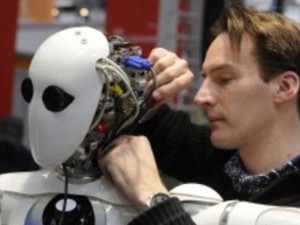
A technician works on the robot AILA at the stand of German Research Centre for Artificial Intelligence (DFKI) during the preparations of the Hannover Messe trade fair for business and industry on the fair grounds in Hanover, northern Germany on April 18, 2010. AFP FILE PHOTO

LONDON – Could computers become cleverer than humans and take over the world? Or is that just the stuff of science fiction?

Philosophers and scientists at Britain’s Cambridge University think the question deserves serious study. A proposed Center for the Study of Existential Risk will bring together experts to consider the ways in which super intelligent technology, including artificial intelligence, could “threaten our own existence,” the institution said Sunday.

“In the case of artificial intelligence, it seems a reasonable prediction that some time in this or the next century intelligence will escape from the constraints of biology,” Cambridge philosophy professor Huw Price said.

When that happens, “we’re no longer the smartest things around,” he said, and will risk being at the mercy of “machines that are not malicious, but machines whose interests don’t include us.”

Fears that machines could overtake humans have long been the subject of science fiction — the computer HAL in the movie “2001: A Space Odyssey,” for example, is one of film’s best-known computer threats.

Price acknowledged that many people believe his concerns are far-fetched, but insisted the potential risks are too serious to brush away.

“It tends to be regarded as a flakey concern, but given that we don’t know how serious the risks are, that we don’t know the time scale, dismissing the concerns is dangerous. What we’re trying to do is to push it forward in the respectable scientific community,” he said.

While Price said the exact nature of the risks is difficult to predict, he said that advanced technology could be a threat when computers start to direct resources towards their own goals, at the expense of human concerns like environmental sustainability.

He compared the risk to the way humans have threatened the survival of other animals by spreading across the planet and using up natural resources that other animals depend upon.

Price is co-founding the project together with Cambridge professor of cosmology and astrophysics Martin Rees and Jann Tallinn, one of the founders of the internet phone service Skype.

The university said Sunday the center’s launch is planned next year.

Follow us on Facebook Follow on Twitter Follow on Twitter


Recent Stories:

CA stops gov’t from pursuing smuggling case vs Phoenix Petroleum 9 mins elapsed Aquino rejects new Charter change bid 10 mins elapsed China’s Xi will meet Obama earlier than expected 12 mins elapsed Yahoo! vows not to ruin Tumblr after $1.1B takeover 48 mins elapsed Fire destroys oil mill in Iligan City 1 hour elapsed Oklahoma twister tracked path of 1999 tornado 1 hour elapsed North Korea releases detained Chinese fishermen—Xinhua 1 hour elapsed No new H7N9 cases in China for a week—government 1 hour elapsed
Complete stories on our Digital Edition newsstand for tablets, netbooks and mobile phones; 14-issue free trial. About to step out? Get breaking alerts on your mobile.phone. Text ON INQ BREAKING to 4467, for Globe, Smart and Sun subscribers in the Philippines.

Tags: Britain , Cambridge University , technology


Copyright © 2013,
.
To subscribe to the Philippine Daily Inquirer newspaper in the Philippines, call +63 2 896-6000 for Metro Manila and Metro Cebu or email your subscription request here.
Factual errors? Contact the Philippine Daily Inquirer's day desk. Believe this article violates journalistic ethics? Contact the Inquirer's Reader's Advocate. Or write The Readers' Advocate:
c/o Philippine Daily Inquirer Chino Roces Avenue corner Yague and Mascardo Streets, Makati City, Metro Manila, Philippines Or fax nos. +63 2 8974793 to 94
Advertisement

News

  • CA stops gov’t from pursuing smuggling case vs Phoenix Petroleum
  • Aquino rejects new Charter change bid
  • Fire destroys oil mill in Iligan City
  • Oklahoma twister tracked path of 1999 tornado
  • North Korea releases detained Chinese fishermen—Xinhua
  • Sports

  • Aces not one and done, says Uytengsu
  • What a class act by Alaska
  • Caluag rules Asian BMX Elite category
  • Emperado claims 2nd GM victim, shares lead
  • Fruitas, Boracay seek semis berths Tuesday
  • Lifestyle

  • Olongapo nurse crowned Miss PH-Earth on second try
  • These dogs can fly– and that includes asPins, too
  • Hair: It doesn’t only reflect your beauty, it also says something about your health
  • Learn ‘the ropes’ to get in shape
  • Can the ability to bilocate be inherited?
  • Entertainment

  • Single Review: ‘Up In The Air’ by 30 Seconds To Mars
  • Arnel Pineda: Journey to go on a hiatus after 2016
  • Heard: Sir Chief on being ‘Papa-ble!’
  • Double victory for Yllanas
  • K-pop’s G Dragon eager for challenge of solo tour
  • Business

  • Asia shares down ahead of Bernanke testimony
  • US stocks dip despite M&A activity
  • MyxTV launches app on Roku
  • Asian shares higher on US gains
  • PH approves three new wind farms
  • Technology

  • Yahoo! vows not to ruin Tumblr after $1.1B takeover
  • Yahoo! confirms Tumblr deal for $1.1B
  • Mobiles offer financial lifeline to Asian migrants—study
  • Metro’s traffic situation may now be monitored via smart phones, tablets
  • Yahoo! to buy blog-maker Tumblr for $1.1B—report
  • Opinion

  • Editorial cartoon, May 21, 2013
  • Reliance on remittances
  • Shattered bamboo reeds
  • Ideal worlds
  • The sheer inadequacy of single-factor analyses
  • Global Nation

  • China’s Xi will meet Obama earlier than expected
  • Fil-Ams voted for 10 of 12 Aquino-backed candidates
  • Different versions of letter of apology show insincerity—Taiwan representative
  • Manila, Taipei agree on ‘cooperative’ probe
  • Saudi signs accord to protect PH maids
  • Marketplace
    Advertisement
    © Copyright 1997-2013 INQUIRER.net | All Rights Reserved