Quantcast
Latest Stories

’17 billion’ Earth-sized planets in Milky Way—study


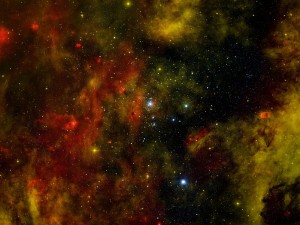
The Milky Way and other galaxies in the universe harbor many young star clusters and associations that each contain hundreds to thousands of hot, massive, young stars known as O and B stars shown in this NASA image obtained on November 12, 2012. AFP FILE PHOTO

WASHINGTON—The Milky Way contains at least 17 billion planets the size of Earth, and likely many more, according to a study out Monday that raises the chances of discovering a sister planet to ours.

Astronomers using NASA’s Kepler spacecraft found that about 17 percent of stars in our galaxy have a planet about the size of Earth in a close orbit.

The Milky Way is known to host about 100 billion stars, meaning that about one of every six has an Earth-sized planet around it.

The finding does not mean that all those planets beyond our solar system, or exoplanets, could be habitable, though it increases the chances of finding planets similar to Earth.

In order to host life, and allow water to flow in liquid form, a planet must be at a distance from its star that allows surface temperatures to be neither too hot nor too cold.

The Kepler craft detected possible exoplanets when they passed in front of their star, creating a mini-eclipse that dims the star slightly.

During the first 16 months of the survey, Kepler identified about 2,400 candidates.

Francois Fressin, of the Harvard-Smithsonian Center for Astrophysics, and his colleagues used the results to determine which signals were true and to list the exoplanets by size.

They found that 17 percent of stars have a planet 0.8 to 1.25 times the size of Earth in an orbit of 85 days or less.

About a fourth of stars have a super Earth (1.25 to twice the size of Earth) in an orbit of 150 days or less, with a same fraction having a mini Neptune (two to four times Earth) in orbits up to 250 days long.

Larger planets are a much rarer occurrence. Only about three percent of stars have a large Neptune (four to six times Earth) and only five percent have a gas giant (six to 22 times Earth) in an orbit of 400 days or less.

The researchers presented the analysis at a meeting of the American Astronomical Society in Long Beach, California.

Separately, NASA’s Kepler mission announced it had discovered 461 new possible planets.

Four of them are less than twice the size of Earth and orbit their sun’s “habitable zone,” where liquid water might exist on the planet’s surface and thus make life possible.

The findings, based on observations conducted from May 2009 to March 2011, showed the number of smaller-size planet candidates and the number of stars with more than one candidate steadily rising.

Follow us on Facebook Follow on Twitter Follow on Twitter


Recent Stories:

Marikina City fire traced to second-hand ref 41 mins elapsed Int’l migrant group appeals for protection of Filipino workers in Taiwan 46 mins elapsed ‘Election is over, let’s work together’—Nancy Binay 2 hours elapsed Zest Air cancels flights to Taipei 2 hours elapsed PSE board gets new manadate 2 hours elapsed It’s up to MMDA chief to explain jump in net worth–Palace 2 hours elapsed MMDA chief: No new assets, just different SALN form 2 hours elapsed ‘Prove them wrong,’ Binay tells daughter 2 hours elapsed
Complete stories on our Digital Edition newsstand for tablets, netbooks and mobile phones; 14-issue free trial. About to step out? Get breaking alerts on your mobile.phone. Text ON INQ BREAKING to 4467, for Globe, Smart and Sun subscribers in the Philippines.

Tags: Astronomy , Earth , Milky Way

  • http://pulse.yahoo.com/_DN4EWLEZKUJA7YJD2GGCFAB2YM michael l

    There may be 17B planets out there in the vastness of the outer space. Man may plan and program to send space expeditions in the guise of exploring the OUTER SPACE, but Man still has to explore and to contend in his INNER SPACE (the soul within).

  • blainz

    Some thoughts…

    Reflecting upon this multitude of planets, it is natural to speculate on the possibility of life, even intelligent life, on some of them. Finding microbe fossils on Mars (or Martian meteorites) will strengthen the likelihood of life in other worlds. However, the Fermi Paradox, implied in malek abdul’s post below, leads one to conclude that intelligent life must be uncommon in the Milky Way, for given a hundred millenia, an eyeblink in cosmic time, an advanced civilization will have made its presence obvious in broad swaths of the electromagnetic spectrum (unless they practice stealth, or blow themselves up on reaching a certain technology level).

    Alternatively, these civilizations could be so advanced humanity wouldn’t qualify as intelligent to them, with technology alien to the wildest imaginings of physicists, and we as yet do not have the means to detect their existence.

    As an historical aside, let’s all be glad we’re not in 16th century Europe. A certain Giordano Bruno, voicing thoughts about alien life with alien gods on alien planets, got this treatment from the Catholic Church – imprisonment in chains, sunk in a pit barely wider than his shoulders, flogging, tortured at the rack, having a spike driven through his tongue, and being burned at the stake. It’s been a while since I read a book about his fate, so I’m sure I missed an odd torture or two.

    A toast to GB; may a life-holding planet among these billions be named after you.


Copyright © 2013,
.
To subscribe to the Philippine Daily Inquirer newspaper in the Philippines, call +63 2 896-6000 for Metro Manila and Metro Cebu or email your subscription request here.
Factual errors? Contact the Philippine Daily Inquirer's day desk. Believe this article violates journalistic ethics? Contact the Inquirer's Reader's Advocate. Or write The Readers' Advocate:
c/o Philippine Daily Inquirer Chino Roces Avenue corner Yague and Mascardo Streets, Makati City, Metro Manila, Philippines Or fax nos. +63 2 8974793 to 94
Advertisement

News

  • Comelec proclaims final three senators
  • Marikina City fire traced to second-hand ref
  • Police arrest call center executive
  • Youngest gov to rule CamSur
  • Arroyo vows better service in 2nd term in Congress
  • Sports

  • US training pays off as returning San Beda nips FEU at Filoil Flying V
  • UE draws perfect game from Olivarez to thwart UST
  • Adamson bests CSB on Jericho Cruz’s 25-point burst
  • Report: Michael Phelps planning comeback
  • Former lawyer says OJ Simpson knew about guns
  • Lifestyle

  • Make the good choice with Android Handsets
  • Caribbean talks conservation on Branson’s island
  • My (forced) Boracay summer of 2013
  • Daisy Hontiveros Avellana–Why she will always be the ‘First Lady of Philippine Theater’
  • ‘The only thing wrong with the Filipino audience is that there isn’t enough of it’
  • Entertainment

  • Flamboyant celeb wins back beau via intrigue
  • Leaving a coliseum full of positive vibes
  • Ser Chief, Maya in Toronto today
  • HEARD: Celeb poll volunteer
  • J.J. Abrams: Wildly exciting to direct new ‘Star Wars’
  • Business

  • PSE board gets new manadate
  • World hypertension day: Know your numbers
  • Mining output plunged 18% in 2012
  • Stocks continue to decline
  • AUB debuts strong on PSE
  • Technology

  • Hong Kong launches first electric taxis
  • DepEd website now up and normal
  • Report: Yahoo nearing $1.1B acquisition of Tumblr
  • ‘Sonic’ video games coming to Nintendo
  • ‘Hatchet hitchhiker’ arrested in US murder
  • Opinion

  • An interesting challenge
  • Premature, imprudent and illegal
  • Nations and their governments
  • Come, Holy Spirit!
  • A room in heaven
  • Global Nation

  • Int’l migrant group appeals for protection of Filipino workers in Taiwan
  • Zest Air cancels flights to Taipei
  • No alternative for Filipino workers in Taiwan, says recruitment expert
  • De Lima appeals for calm as NBI completes probe into Taiwanese fisherman’s killing
  • Mexico violence claims hundreds of US lives
  • Marketplace
    Advertisement
    © Copyright 1997-2013 INQUIRER.net | All Rights Reserved