





What happens when Philippine enterprises try to deploy AI


Srini Tallapragada has a metric he uses to measure whether AI is actually working in an enterprise. It’s not how many tokens the model processes. It’s not benchmark scores or YouTube demos showing how smart the latest LLM has become. It’s simpler than that: did it show up on the P&L?
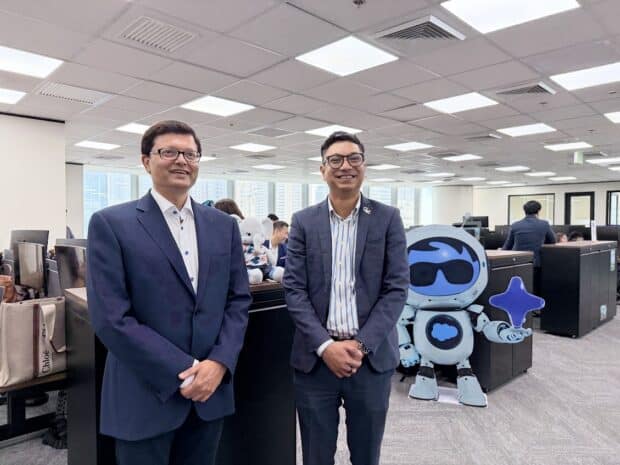
“Every CEO I talk to, every board member — they all want to become an AI-driven enterprise,” says Tallapragada, Salesforce’s President & Chief Engineering and Customer Success Officer, who was in Manila this year for the company’s Philippine office opening. “But when you ask if AI had a real impact on your business — on growth, on cost — people are not seeing it in their profit and loss statements.”
Salesforce calls this the “last mile problem.” The gap between what generative AI is supposed to do and what it actually delivers in an enterprise context. It’s the reason the company is betting on the Philippines not just as a customer base, but as a proving ground for whether enterprise AI can move past the pilot stage.
The Infrastructure Gap
The problem isn’t the models. LLMs are getting better every week — beating benchmarks, outperforming Nobel Prize winners in specialized tasks, generating increasingly coherent outputs. The issue is what happens when you try to deploy them inside a regulated enterprise with legacy systems, proprietary data, and compliance requirements.
“These models are trained on public data,” Tallapragada explains. “They don’t have access to what’s local to your company, what’s unique to your operations. If you’re a bank giving out loans, you can’t have the AI just guess. If a CEO asks what revenue was this year, you can’t have a probabilistic model to make something up.”
Then there’s auditability. In regulated industries — banking, healthcare, utilities, telcos — a regulator might show up 12 to 18 months after a decision and ask: how do you know your AI didn’t discriminate against this applicant? If you can’t trace back exactly what the model did on a specific day with a specific customer query, you’re exposed.
This is where the raw intelligence of an LLM breaks down in the enterprise. The model is powerful, but it has no context, no memory of your internal systems, no framework for operating within compliance guardrails. Salesforce’s answer is Agentforce, a platform designed to take the AI and make it work within that structure — connecting it to company data, enforcing auditability, reducing hallucinations.
The platform’s annual recurring revenue (ARR) is growing at over 200% year-over-year. Salesforce now has more than 29,000 closed deals, with Agentforce generating over $800 million in ARR. Airlines like Singapore Airlines, Air India, and Heathrow Airport are using it to handle complex customer service queries. But Tallapragada is quick to clarify that customer success outlasts revenue when it comes to long term outlook.
“What we’re proud of is that thousands of customers are already live and using it. That’s what matters — not just who bought it, but who’s getting value.”
Why the Philippines
The Manila office opened in November, but Salesforce has been operating in the Philippines for years. What changed is the scale of commitment. The company now has a full team covering sales, solutions engineering, and professional services — all based locally. Abraham Cuevas, the Regional Vice President and Country Manager for Salesforce Philippines, says the market has reached a tipping point.
“Philippines is one of Salesforce’s fastest-growing markets in ASEAN.” Cuevas says. “We’ve been engaging customers here for a while, but now we’re investing in all aspects of the business. We see this as a key market.”
Part of that is timing. Philippine enterprises and mid-market companies are facing the same AI adoption challenge as their global counterparts: they know they need to move, but they’re not sure how to extract real business value from the technology. BPO firms are grappling with automation and reskilling. Banks and telcos are navigating regulatory pressure while trying to modernize legacy infrastructure. Healthcare providers are looking for efficiency gains without sacrificing compliance.
Salesforce’s pitch is that it’s solved this problem elsewhere, and the Philippines is where it can prove the model works at scale across different sectors.
One example Cuevas gives is Maxicare, a local HMO. Every time a patient goes to the dentist, they need a letter of authorization — a manual process that involves filling out forms, sending emails, and waiting for approval. The administrative cost often doesn’t justify the value of the dental visit itself. Maxicare deployed Agentforce to automate that approval process. The cost efficiency improvement was significant, but more importantly, the workflow didn’t break. The AI handled the task within the existing system constraints.
It’s not flashy. It’s not a chatbot that writes poetry or generates images. It’s infrastructure — the boring, essential work of making AI useful in regulated industries where mistakes have consequences.
The Enterprise Readiness Question
There’s a broader question embedded in Salesforce’s Philippines expansion: is the market ready for this?
Tallapragada is blunt about the challenge. Globally, billions of dollars have been poured into AI infrastructure over the past three years. Most of it hasn’t translated into GDP impact. Companies are experimenting, but they’re doing it themselves — building custom solutions, integrating models piecemeal, hoping something sticks. The result is a lot of investment with limited return.
“The gap is real,” he says. “Companies are not growing faster because of AI. Their P&L statements aren’t showing the impact. That’s the problem we’re solving — not just selling technology, but helping customers get value.”
For Salesforce, that means acting as a partner, not just a vendor. The company’s approach is to translate AI capabilities into business language that executives understand: how do you generate more leads, convert more opportunities, reduce support time, and improve operational efficiency?
It’s less about what the AI can theoretically do and more about what it actually changes in day-to-day operations.
In the Philippines, that translates differently depending on the sector. For BPO firms dealing with skills gaps and automation pressure, it’s about augmenting agents rather than replacing them. For banks navigating fintech competition, it’s about faster loan origination and better fraud detection. For healthcare, it’s operational efficiency without sacrificing patient care quality.
Salesforce is also working with the government on training initiatives, though Tallapragada is careful not to overpromise. “We work with every government and civil society to help create training programs. It’s a new tool. Everyone needs to learn how to use it responsibly.”
The company introduced a new metric alongside revenue growth: the “agentic work unit.” Instead of measuring tokens processed — a technical stat that doesn’t correlate to business outcomes — Agentforce tracks actual work completed by AI agents. It’s an attempt to ground the conversation in something tangible: did the AI do something useful, or just generate output?


