
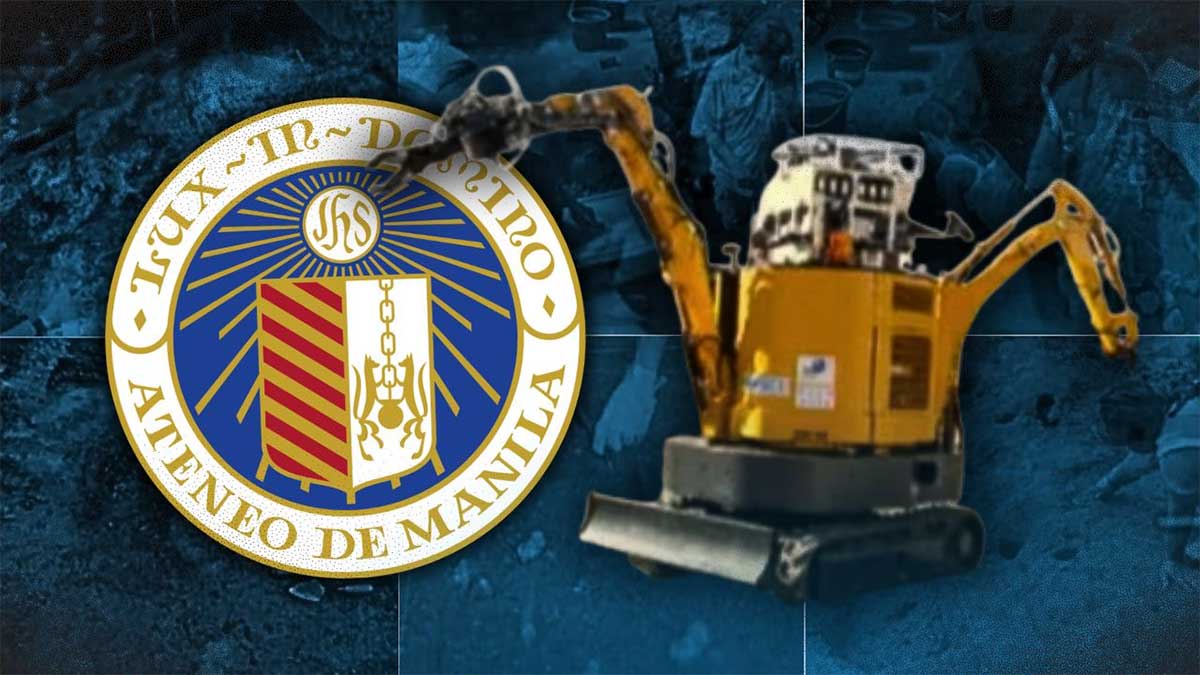
MANILA, Philippines — A robot developed in collaboration with the Ateneo Laboratory for Intelligent Visual Environment (Alive) is “reshaping how we explore our distant past.”
Long before the first Spanish vessels arrived in the Philippines in the 1500s, islands across the archipelago were already home to seafarers who crossed straits, island chains and open seas that were once thought to be impassable to humans.
Alfred Pawlik, a professor at Ateneo de Manila University’s Department of Sociology and Anthropology, showcased early stone tool artifacts in a public lecture, detailing archaeological evidence of the “seafaring and hunting strategies used by early inhabitants hundreds of thousands of years ago to thrive.”
RELATED STORY: Indigenous ‘indio genius’
Drawing from fossil, artifactual and radiometric evidence, Pawlik examined “how these early peoples adapted to demanding coastal and island environments, developed sophisticated hunting, fishing and seafaring practices, and forged connections across vast stretches of ocean.”
He said that around 40,000 years ago, humans were already venturing across island chains such as Palawan and Mindoro.
Pawlik added that earlier people reached Luzon hundreds of thousands of years ago, not as accidental wanderers but as deliberate and repeated sea crossers.
RELATED STORY: Stone tools age Asia’s first Homo presence
Central to this movement is the “Palawan-Mindoro Corridor,” a likely route that positions the Philippines not as a remote endpoint, but as a critical gateway in the wider story of human migration across Southeast Asia. Pawlik said recent archaeological discoveries also show how capable these early communities were.
But survival on these islands demanded more than skill at sea.
As ADMU’s Research, Creative Work, and Innovation Portal pointed out, early people also depended on plants to thrive. Far from being passive settlers, they were adaptive innovators who learned to work with the rhythms and risks of both land and ocean.
In his lecture, Pawlik introduced ArchaeoBot, described as a collaboration with Alive.
By integrating robotics and machine learning into archaeological excavation, the project aims to enhance precision, minimize human error, and reveal details that deepen the understanding of early human life in the region.
Pawlik said the robot was designed to help excavate sites with greater consistency, precision and care than manual methods.
The robot is equipped with different sensors that allow it to identify possible artifacts, burials, hearths and other subtle traces that people might miss or only notice too late.
Using ArchaeoBot, experimental and interdisciplinary efforts will reconstruct not only artifacts but entire systems of knowledge, making visible the invisible technologies that rarely survive in the archaeological record. /dm