
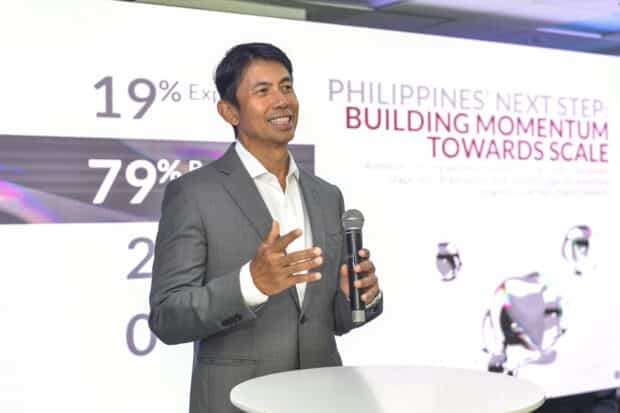
ST Telemedia Global Data Centres (STT GDC) has released its latest Philippines-specific findings across 62 local organizations integrating and adopting AI in comparison with countries in Asia like Japan, South Korea, Singapore, and many other Southeast Asian countries. President and CEO of STT GDC Carlo Malana presented the data under Mind the Gap: Bridging the AI Infrastructure Readiness Divide event last April 22 at STT Makati. The Philippines has grand ambitions with AI growth and integration but is largely falling behind its neighbors in terms of execution, infrastructure, and talent training.
The study shows that 79% of Philippine organizations are now in the “Builder” stage of AI adoption, actively deploying early operational AI solutions versus Asia’s average of 71%. However, only 2% have progressed to the “Integrator” stage and none have reached “Leader” status, while 19% remain in the Explorer phase, highlighting a sharp drop‑off beyond initial deployment and signaling structural barriers to scale.
With the majority of the Philippines still in the build phase, the country really is playing catch up in the AI infrastructure field. On average the Philippines takes 12-18 months to build foundations but AI technology updates every 6-12 months. So the country’s timelines with infrastructure alone are very skewed. AI is growing fast. If you remember how ChatGPT was a year ago, it was even laughable to an extent, to how it is today it has come a long, long way with analysis and execution so it really is more important than ever.
With this time line, it is more plausible for companies and organizations to find partners with specialized entities to catch up in a more efficient manner. The approach grants more immediate access to necessary digital infrastructure and expertise. This could reduce the build timeline from 12-18 months to 3-6 months letting companies catch up with the fast adopting AI technology updates.
Capital and ROI pressure is a big issue for 56% of the companies involved. When everything started out many years ago it was just 2 or 3 kilowatts per rack for a data center but now it goes up to 20-40 kilowatts in consumption. The top of the line models need as much as 130 kilowatts so cooling chain tech alone is already going to be very expensive. AI needs to be sustainable with how expensive it can get to run but it interestingly wasn’t a priority for the companies that responded. ROI without setting up the infrastructure isn’t exactly going to get very far.
Talent shortages are compounding these challenges further. More than three‑quarters (76%) of organizations report critical AI talent gaps, while 53% acknowledge they lack the in‑house expertise required to manage complex AI infrastructure and operations. Beyond specialist skills, workforce readiness remains uneven: 94% of respondents describe their organizational culture as skeptical, cautious or ambivalent towards AI, suggesting that adoption challenges extend beyond technology into organizational change and operating maturity.
“The data shows a clear pattern — Philippine organizations are investing and experimenting with AI, but many are reaching an infrastructure and capability ceiling,” said Malana. “Compute, storage and connectivity constraints, combined with a shortage of specialized operational expertise, are making it difficult to move from pilots to reliable, scaled deployment. Addressing these challenges together is essential if organization’s are to fully realize the value of AI.”
On regulation of data privacy in the Philippines, Malana also added. “I’ll comment from the study but the regulatory initiative to decentralize is lacking. Over 90% percent cloud capabilities of the PH are done outside the country. These are government resources. We can’t run government operations with data that’s abroad. We have no sovereignty over our data. Circumstances happen around the world so there is more importance for that infrastructure to be set up for safety. We shouldn’t put our eggs in a basket that’s not even in our country.”
Looking ahead, the research points to a growing future readiness gap. Nearly half (46%) of respondents expect AI workloads to grow by more than 50% over the next one to three years, yet only 3% say they are currently ready to scale high‑demand AI workloads. At the same time, 86% report investing 5% or less of their total IT budgets in AI, raising questions about whether current investment levels and infrastructure strategies are aligned with future growth expectations.
The Philippines is an ambitious country with AI that much is certain but how far can ambition get you if you don’t have the infrastructure to sustain or the talent to manage?