MANILA, Philippines – The Department of Science and Technology (DOST) introduced the Swift Emergency Response Vehicle Integration System with Smart Traffic and Electronic Enforcer on the Road (sERVis-STEER) project for a smarter and swifter emergency transport response dispatching.

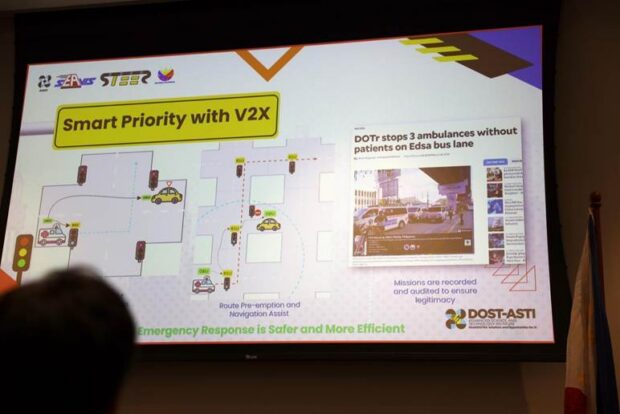
Developed through its Advanced Science and Technology Institute (DOST-ASTI), the sERVis-STEER project aims to help emergency response vehicles (ERVs) navigate heavy traffic more efficiently.
The project uses Vehicle-to-Everything (V2X) wireless technology, which allows ERVs to communicate directly with roadside units and traffic infrastructure.
The system can automate routes and trigger intelligent green lights, enabling ERVs to pass through intersections more quickly.
RELATED STORY: DOST invests over P4.99M to develop model for ultrasound training
Full partnership with LGUs, partners
DOST Secretary Renatu U. Solidum Jr., expressed the need for full cooperation between local government units (LGUs) and its partner agencies.
“We need a full partnership of our local government units, partner agencies, and all of you to bring the same sense of urgency that our emergency responders bring to the road every day. DOST has always believed that science is most meaningful when it reaches the people who need it most,” Solidum said.
RELATED STORY: DOST launches new tech testing and validation initiative
Towards a smart Philippines
The project features the Emergency Response Information Exchange Server Platform, a centralized system to enable real-time monitoring among agencies, hospitals, and dispatch centers.
sERVis-STEER is led by Engr. Ramon Vann Cleff B. Raro and presented by Miguel D. Asido of DOST-ASTI.
The project is part of a wider implementation of the Intelligent Transportation System (ITS) in the Philippines. DOST-ASTI has focused on road safety, emergency response, and adaptive traffic control.