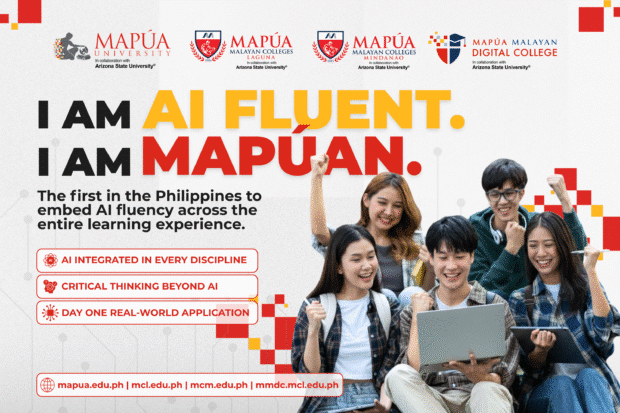
MANILA, Philippines – The Mapua Education Group and Arizona State University (ASU) announced the Philippines’ first Artificial Intelligence (AI) Fluency Strategy in the academe last June 22.
The joint initiative aims to empower and equip students to master human-AI collaboration and solve complex real-world problems, beyond basic AI knowledge.

AI Literate and AI Fluent: What’s the difference?
The Mapua Group views AI literacy as the baseline standard for learning new technology, defining it as the ability to understand AI, how it runs, its limitations, and ethical and responsible usage.
While it is essential, educators have stressed that basic AI literacy is no longer enough to remain competitive in an expanding technological landscape.
With other higher education institutions focusing on introductory AI, the Mapua Group is expanding to AI fluency, a skill that combines tool usage with deep expertise and critical evaluation in their respective disciplines.
AI fluency aims students to be equipped on when to use AI, how to question its outputs, and how to apply disciplinary standards when it produces errors or bias.
Dodjie Maestrecampo, President and CEO of Mapua Group, noted that the country’s tertiary education must produce graduates who can work with AI responsibly and productively to stay globally competitive.
The Blueprint
The strategy introduces comprehensive upgrades across the entire student lifecycle through a four-layer curriculum integrated across all programs, namely: AI for all, AI in the discipline, AI for learning, and advanced AI pathways.
Additionally, the blueprint will lean on two major structural innovations: The ‘HyFlip’ pedagogical model and the process-based assessment framework.
The HyFlip model will create an inverted classroom setup, enabling AI-supported asynchronous study and preserving vital class hours for debate, problem-solving, and mentoring.
Meanwhile, the process-based assessment framework will include coursework in programs classified as AI-prohibited, AI-assisted, or AI-integrated tasks.
This framework shifts evaluation from the final output to the student’s critical-thinking process.
“Ushering in the era of AI requires Mapua to redesign not only what we teach, but how we teach, how we assess, how we conduct research, and how we operate as an educational institution. It is imperative to make AI fluency a common competency of Mapua graduates,” Maestrecampo said in a press release.
New tools for faculty and alumni
With the new institution-wide system transition, the university has provided support tracks and tools for faculty and alumni.
First, the Mapua AI Teaching Commons, which is a new platform that helps educators build their instructional capacity as cognitive coaches.
Next are the stackable microcredentials, where both faculty and alumni can obtain industry-recognized AI fluency microcredentials that are embedded directly into degree tracks.
And earlier this year, the Mapua Education Group launched a group-wide collaboration with OpenAI that provides advanced AI features and tools for students, faculty, and employees.
“We are in the next stage of Mapua’s continuing mission—to prepare learners who can lead in a changing world, contribute to industry and society, and advance nation-building. Mapua must not only adapt to the age of AI; Mapua must help shape it,” Maestrecampo also added.
The group, consisting of Mapua University, Mapua Malayan Colleges Laguna (MMCL), Mapua Malayan Colleges Mindanao (MMCM), and the Mapua Malayan Digital College (MMDC), will begin rolling out the system-wide initiative in the upcoming Academic Year 2026-2027. (By Clyde Jan Pascual, INQUIRER.net Contributing Writer)