





Gerrymandle: A fun way to steal elections


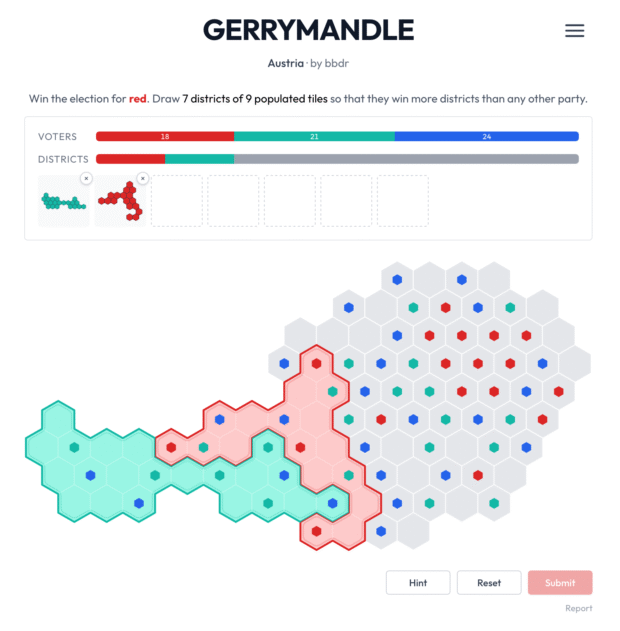
MANILA, Philippines – Do you still play Wordle, that viral word game that came out in 2021 then got bought by The New York Times in 2022? I still solve Wordle every day—on hard mode!—and have played a total of 1,620 days. (I only missed 26 days since I started in January 2022, and have a solve rate of 98%.)
I also remember the numerous derivative games that were created in Wordle’s wake, most adopting the “-le” suffix and having a daily puzzle mechanic. Some of them expanded on Wordle’s word game concept, like Quordle, where you solve 4 words at once. Others explore subject areas aside from word guessing, such as Globle, where you try to identify the daily mystery country. You can browse through nearly every such game on Listdle if you want more daily challenges.
One of the latest entries in this genre is Gerrymandle. Your aim in the game is to create electoral districts so that your chosen political party wins more districts than other parties. The game was created by an indie solo developer with the handle realmofthemad, and they announced it on Hacker News on June 18.
RELATED STORY: Indie games to look out for at PGDX 2026
A very timely game
If you’re not yet familiar, gerrymandering is the political practice of manipulating the boundaries of electoral districts to provide a party or group with an advantage in representative bodies, such as congress, parliament, or a local council.
Gerrymandering has been a pretty hot topic lately if you’re following U.S. politics because both the Republican and Democratic parties have been redrawing their congressional districts to try to retain or gain control of the U.S. House of Representatives in the upcoming November 2026 elections. This is highly unusual because congressional districts typically only get redrawn following the decennial census, which last happened in 2020.
In the Philippines, malapportionment—districts with wildly different populations—is arguably a bigger issue than gerrymandering. The smallest district, the one for Batanes, represents only 19 thousand residents, while the largest, Rizal’s first district (which includes Cainta and Taytay), covers over 1.2 million people! But gerrymandering does occur in the form of attempts to split provinces, like with Palawan in 2021 and Cebu in 2005.
Fun and educational too!
At least in the United States, gerrymandering happens via packing and cracking. Packing involves grouping as many of the opposing party’s voters into one district so that they don’t influence other districts. And cracking is splitting the other party’s voters into many districts such that they don’t gain a majority in any of those districts.
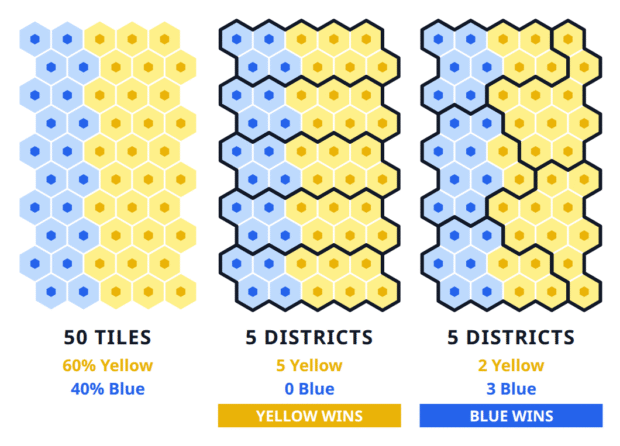
Gerrymandle provided a very good illustration (shown above) of these two techniques. In this hypothetical state, 40% of the citizens vote for the Blue party while the remaining 60% vote Yellow. Their council has five seats and you normally expect Blue to have two and Yellow three if the districts were drawn fairly.
But if the Yellow party draws the districts by cracking the Blue voters like in the second example, they win all five districts, shutting out the Blue party. However, if the Blue party draws the districts like in the third example by packing as many Yellow supporters into two districts, the remaining Yellow voters are not enough to defeat the Blue majority in the other three districts.
Reading about packing and cracking is one thing. Actually drawing districts yourself via a game like Gerrymandle is another. After solving a few puzzles, you begin to intuitively understand how a party can win a majority of seats without winning a majority of votes.
This is my new favorite daily puzzle game
I’ve played a few other gerrymandering games before, but Gerrymandle hits the sweet spot of providing enough of a challenge while being packaged as a casual game that you can solve during your 15-minute break. I also like that the game provides empty spaces and the possibility of tied districts (which never happens in real life) to add interesting mechanics to the puzzles.

The game also lets you create your own puzzles, solve other people’s submitted puzzles, and solve any of the past daily puzzles—features that The New York Times puts behind a subscription paywall for Wordle. And if you get stuck, you can get hints.
I still play Wordle, but I’m really happy to have added Gerrymandle to my daily puzzle routine.
RELATED STORY: Should I buy a Switch 2 right now?


