





Why are data center operators moving to the Philippines?


The Philippine digital economy is growing at 20% per year. Data center capacity is expanding at the same rate. Foreign direct investment is hitting $9 billion annually. Those numbers require physical infrastructure, and that infrastructure is starting to look different.
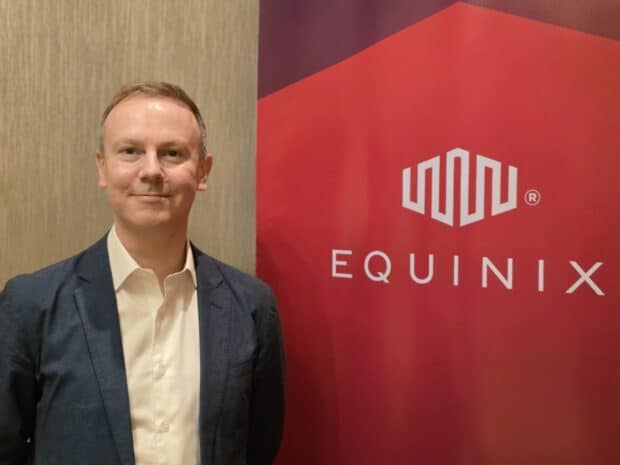
Max Parry, Vice President for Growth & Emerging Markets at Equinix Asia Pacific, was in Manila recently following the company’s acquisition of three data centers here last year. Equinix operates 280 data centers globally, and the Philippines was a deliberate addition — not because of market size alone, but because of what’s happening underneath.
The BPO shift
The Philippines has always had competitive advantages in BPO — English fluency, cultural alignment, cost efficiency. But the sector is shifting. Voice-based support is flattening. What’s growing is back-office processing, IT services, and AI-augmented workflows that still require human oversight but operate at higher scale.
That creates different infrastructure demands. BPO firms need low-latency connections to cloud providers, direct access to enterprise clients’ private networks, and hybrid setups where some workloads run locally and others run in AWS, Azure, or Google Cloud. The old model — a data center leasing space to one or two anchor tenants — doesn’t support that.
Equinix’s approach maximizes diversity. Globally, they have, rounded off, 10,000 customers: 2,000 networks, 3,000 cloud and IT providers, 5,000 across other industries. The value is both the physical space and the ability to directly connect to any of those partners without a third party in the middle. Parry calls it “interconnection,” with Equinix hitting 500,000 direct interconnections globally. For a Philippine enterprise, if you need to connect to a cloud provider, payment gateway, or international partner, the infrastructure is already there.
Growing fintech demand
The other driver is financial services. The pandemic accelerated digital payments and fintech adoption in the Philippines. That growth didn’t slow after 2020. Equinix’s Manila data centers already host a concentration of banking customers, creating a network effect. If your competitors or partners are colocated in the same facility, it’s faster and cheaper to connect directly.
That matters for compliance. Banks and fintech companies need auditability, low latency, and redundancy. Equinix’s infrastructure includes dual connections between sites and disaster recovery built into the architecture — the resilience regulators expect when asking about uptime and data sovereignty.
Not sexy, but necessary
Parry talked about AI practically: high-performance AI services require high-performance infrastructure. That means direct connectivity to GPU clusters, access to data lakes, and the ability to deploy workloads close to end users to reduce latency.
The Philippines has the demand — enterprises want AI-driven customer service, fraud detection, content moderation, recommendation engines. What’s been missing is the infrastructure layer that makes those services viable at scale. Equinix’s three Manila data centers (one in Makati, two in Carmona) have about 4MW of capacity, 35,000 square feet of colocation space, and roughly 1,000 cabinets available for expansion. That’s not just rack space. It’s the connectivity backbone that lets Philippine companies plug into global AI platforms without building everything in-house.
Philippines was the SEA missing piece
When global data center operators move into a market, two conditions are usually met: local demand is growing, and multinational customers are asking for support in that geography. Equinix’s customers told them they needed presence in the Philippines. That’s why the acquisition happened.
Parry mentioned Equinix expanded into Malaysia and Jakarta in the last three years. The Philippines was the missing piece in their Southeast Asia footprint. The fact that they’re already looking at future expansion roadmaps suggests they think the 20% annual growth rate isn’t slowing down.
The harder question is whether Philippine enterprises are ready to take advantage of what’s being built. The data centers exist. The interconnections are available. The question now is whether local companies — especially those outside the usual BPO, banking, and telecom sectors — understand what’s possible when the plumbing is in place.


