





SFFPC and the AI industry


The little PC that could?
Here’s five reasons why we’ve been looking at the “small form factor PC” (SFFPC) because of the so-called “AI revolution.”
The shift to remote work and AI-driven workflows has changed how businesses think about hardware. Laptops have been the default for mobility, but as more companies rely on remote desktop infrastructure and edge AI processing, small form factor PCs (SFFPCs) are emerging as the more practical solution — especially for workloads that prioritize performance, upgradeability, and total cost of ownership over portability. For freelancers with limited space, these “tiny desktops for tiny desks” are great space savers.
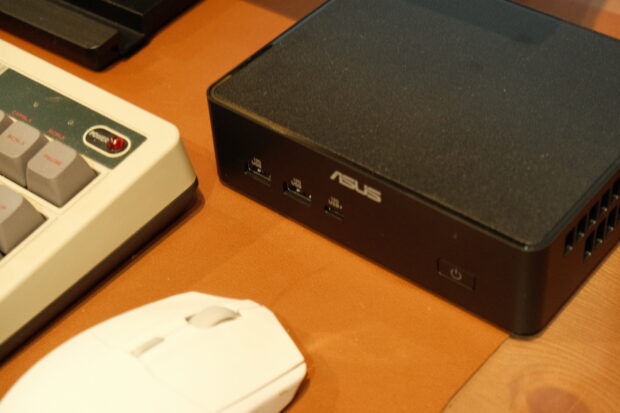
There are a number of brands that offer a SFFPC configuration but ASUS has been all-out with their NUC series, both for enterprise and gaming. Take the NUC 16 Pro, a 5×4 mini PC built specifically for AI-driven enterprise use. It’s not the only SFFPC on the market, but it highlights why this category is gaining traction. Here’s what makes SFFPCs a better fit for the new AI workforce than traditional laptops.
1. Local AI processing without cloud dependency
Laptops are fine for general productivity, but AI inference at scale requires compute power that most thin-and-light models can’t deliver. The NUC 16 Pro uses Intel Core Ultra X9 Series 3 processors with an integrated NPU, Arc B390 GPU, and up to 180 Platform TOPS.
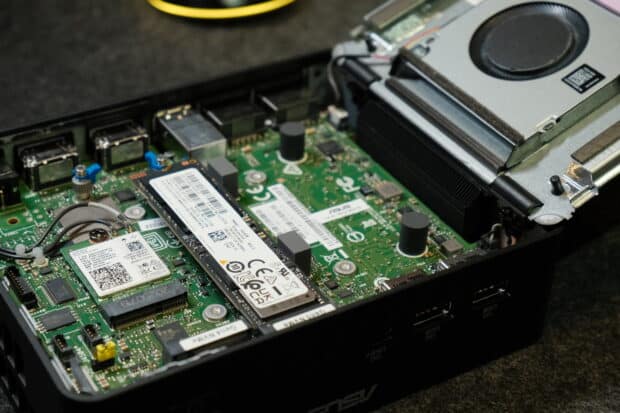
For businesses handling sensitive information — healthcare records, financial data, proprietary research — running AI locally isn’t just faster. It’s necessary. Laptops equipped with NPUs exist, but they’re typically limited to consumer-grade AI tasks like background blur or image enhancement. SFFPCs are designed for heavier workloads: model optimization, RAG (retrieval-augmented generation) pipelines, and multi-modal inference.
ASUS includes its AI SuperBuild toolkit with the NUC 16 Pro, which lets ISVs and system integrators build and deploy custom AI assistants that run entirely offline. That’s not something you’re doing on a laptop without thermal throttling or battery drain becoming immediate constraints.
2. Upgradeability that laptops can’t match
Laptops are sealed units. RAM is soldered. Storage is limited to one or two M.2 slots. Upgrading means buying a new device. SFFPCs are the opposite — modular by design.
The NUC 16 Pro supports up to 96GB of onboard LPDDR5x memory and dual M.2 SSDs (PCIe Gen5 and Gen4). Storage upgrades are tool-less, using a spring-loaded, lever-action chassis that lets IT admins swap drives in seconds. For businesses scaling AI workloads or handling growing datasets, that flexibility matters. You’re not replacing the entire machine when storage or memory requirements increase. You’re upgrading components.
Laptops force a three-to-four-year replacement cycle. SFFPCs extend that timeline by allowing incremental improvements. Over a five-year deployment, that difference in TCO adds up — especially when you’re managing dozens or hundreds of endpoints.
3. Multi-display setups for data-intensive work
Remote work doesn’t mean single-screen workflows. Financial analysts, engineers, data scientists, and developers rely on multi-monitor setups to handle complex tasks — viewing code, dashboards, documentation, and data visualizations simultaneously.
The NUC 16 Pro supports quad 4K displays or dual 8K displays via dual Thunderbolt 4 and dual HDMI 2.1. Laptops max out at two external displays, and even high-end models struggle with 4K rendering at high refresh rates without performance degradation.
For roles that require constant context-switching across multiple data sources — monitoring AI model training, managing cloud infrastructure, analyzing real-time dashboards — the ability to run four independent displays from a single SFFPC is a workflow advantage laptops can’t replicate.
4. Network redundancy and isolation for mission-critical operations
Laptops have one Ethernet port, if they have one at all. Most rely on Wi-Fi. That’s fine for general use, but it’s inadequate for environments where network reliability and security are non-negotiable.
The NUC 16 Pro includes dual 2.5G LAN, which allows businesses to implement Zero Trust architecture by isolating networks. One port handles secure operations — patient data in healthcare, POS transactions in retail, production networks in manufacturing. The other connects to corporate infrastructure. If one network fails, the other maintains connectivity.
This matters for edge AI deployments where uptime is critical. A retail AI system analyzing customer behavior in real time can’t afford downtime because Wi-Fi dropped. Dual LAN with failover ensures continuity. Laptops don’t offer that.
5. Always-on remote management and recovery
Laptops are designed to be shut down, moved, and powered on intermittently. SFFPCs are designed to stay running. That makes them better suited for remote desktop infrastructure, where users connect to a persistent machine rather than relying on local hardware.
The NUC 16 Pro supports Intel vPro on select SKUs (Ultra 5 355, Ultra 7 366H, Ultra X9 388H), which enables out-of-band management through Intel AMT. IT admins can remotely reimage, recover, or troubleshoot devices even if the OS is unresponsive. ASUS calls this One-Click Recovery, and it’s designed to minimize downtime in distributed environments where physical access to endpoints isn’t feasible.
For companies running remote desktop setups or VDI (virtual desktop infrastructure), this is the difference between a two-hour support ticket and a two-minute fix. Laptops don’t offer firmware-level remote control. SFFPCs do.
The cost argument
Laptops feel like the obvious choice because they’re portable. But portability has a cost: sealed designs, limited upgradeability, shorter replacement cycles, thermal constraints that throttle performance under sustained load.
SFFPCs flip that trade-off. They’re stationary, but they’re also modular, upgradeable, and designed for 24/7 operation. For businesses deploying AI workloads at the edge, managing remote desktop infrastructure, or supporting data-intensive roles that require multi-monitor setups and network redundancy, the SFFPC is the more practical solution.
The ASUS NUC 16 Pro is one example of where the category is headed — military-grade durability (MIL-STD-810H), tool-less upgrades, dual LAN, quad display support, and enough AI compute to run local models without cloud dependency. Pricing for the Philippine market hasn’t been announced yet, but the value proposition is clear: fewer replacements, more flexibility, better performance under sustained load.


