





Googlebook unveiled at Google I/O 2026


You heard it right. It’s not Google Books. It’s Googlebook.
It’s been 15 years since the launch of the Chromebook, an affordable alternative to a laptop with Chrome and the Internet as the focus. With the unprecedented developments in AI, the Googlebook is the next iteration in this space. What differentiates the Googlebook from its predecessor is AI capability, with Google fully committing to this AI future with the reinvention of the mouse cursor. The pointer will enable contextual suggestions such as setting meetings when inputting time, or merging photos when highlighting photos in your library.

The Googlebook’s most notable feature is how it reimagines widgets. It brings the power of AI Studio down to the masses allowing anyone to create their own custom widgets by just typing a prompt.
Taking a cue from Apple’s Macbook and iPhone ecosystem, Googlebook pairs extremely well with your Android phone. You can seamlessly run an app on your phone and quickly pick it up on your Googlebook’s larger screen.
The Googlebook comes at a time where the masses have been using AI to generate content commonly referred to as ‘AI slop.’ The Googlebook seems to be a step in a new direction to really show users that AI can be customized to fit specific needs through prompting.
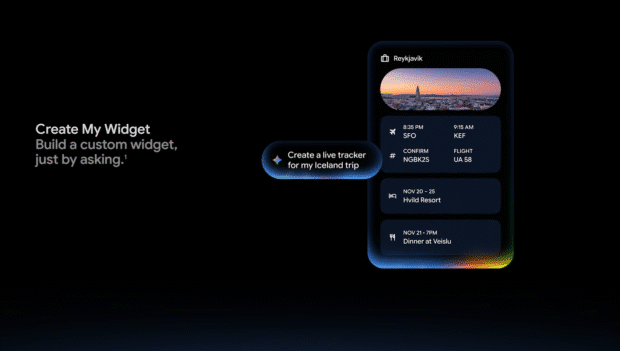
As a hyperscaler, Google has the unfair advantage of Google Cloud, Workspace, Chrome, and other Google apps that can work seamlessly well when combined with AI Studio. The Googlebook is meant to get users involved in building their own widgets in a Google environment. It’s shifting from generative AI to productivity using AI.
Google is working with ASUS, Acer, HP, Lenovo, and other laptop brands to bring Googlebook to the masses.


