





Is the Philippines behind on sovereign AI investment?


From Google Maps rerouting drivers around traffic in real time, to universities deploying AI-assisted research tools, to hospitals using image analysis systems that detect abnormalities in X-rays and CT scans faster — AI is already embedded in everyday operations across multiple industries. Customer service runs on AI chat support. Banks use machine learning for fraud detection. Logistics companies optimize delivery routes through predictive algorithms. The Philippines is rapidly adopting many of these technologies, but much of the infrastructure powering them still depends on foreign cloud providers and overseas-operated systems.
The country has spent the last two years aggressively pushing AI adoption across government and the private sector. Agencies are integrating AI tools into digital services, companies are deploying AI systems internally, and local organizations are moving beyond experimentation. The problem is that the country’s infrastructure remains far behind the scale needed to support those ambitions locally.
The narrative of on-prem AI
The Philippines is still heavily dependent on foreign cloud providers and overseas-operated infrastructure for both enterprise and government systems. Even when services appear localized, many workloads still run through systems owned or operated by international hyperscalers. That raises serious questions around data sovereignty, especially as AI becomes tied to healthcare, education, finance, and government operations.
That bottleneck becomes more critical once AI adoption moves beyond chatbots and lightweight tools. Modern AI systems require large-scale compute infrastructure, GPU clusters, low-latency networking, high-capacity storage, and data centers capable of handling continuous processing loads. Much of that infrastructure still sits outside the Philippines.
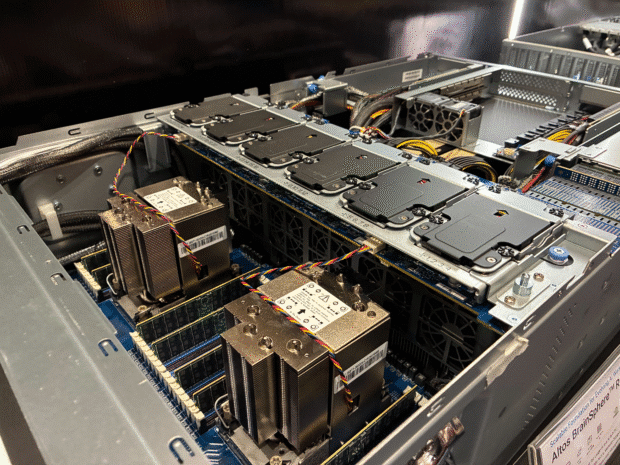
Acer Group subsidiary Altos has introduced a new range of AI workstations and servers, positioning these on-premise systems as a more cost-efficient alternative to cloud AI services over the long term. The company highlighted its BrainSphere Mini AI workstations and servers, alongside its aiGeni and aiWorks platforms, claiming they can deliver cloud-level AI performance at significantly lower cost. According to Paul Chen, Altos Senior Business Development Manager, an on-premises AI setup could pay for itself within the first year and may cost as little as one-third of the total cost of ownership compared to cloud-based AI subscriptions over three years — representing substantial savings for enterprises, government agencies, and educational institutions.
The issue isn’t simply where data is stored. It’s about who controls the infrastructure layer underneath it. Countries investing heavily in AI are no longer focused only on software development — they’re building sovereign compute capacity through local data centers, domestic networking infrastructure, and AI-ready facilities designed to reduce dependence on external providers.
Southeast Asian neighbors are scaling much faster. Thailand recently secured over $1 billion in cloud and AI infrastructure investments from Microsoft alone. Singapore, Malaysia, and Indonesia have spent years positioning themselves as regional hyperscale hubs capable of supporting large enterprise and AI workloads locally.
Is the Philippines behind?
The Philippine government has begun responding through initiatives like the National Artificial Intelligence Center for Research and Innovation (NAICRI) under the Department of Science and Technology, which aims to centralize AI research, advanced computing resources, and infrastructure development. On the private side, STT Global Data Center continues expanding its Fairview campus, while VITRO and other operators are developing larger AI-ready facilities in Cavite, Clark, and nearby regions.
For organizations looking to manage costs while staying AI-capable without full cloud dependence, Altos’s aiGeni and aiWorks platforms offer a practical alternative worth considering.


