





NVIDIA RTX Spark changes the PC forever


There was a time when your laptop was either a bulky gaming desktop replacement or a thin executive-class device. Add the new nuances of AI-enabled laptops running on ARM, you pretty much have different branching paths for choosing your everyday carry laptop.
But what if there was only one path down the line? What if gaming, AI, and portability was found in an all-in-one setup? It seems that NVIDIA has solved that problem with the launch of the RTX Spark, a power SoC platform that aims to compete with Apple, Intel, AMD, and other ARM-based laptops.
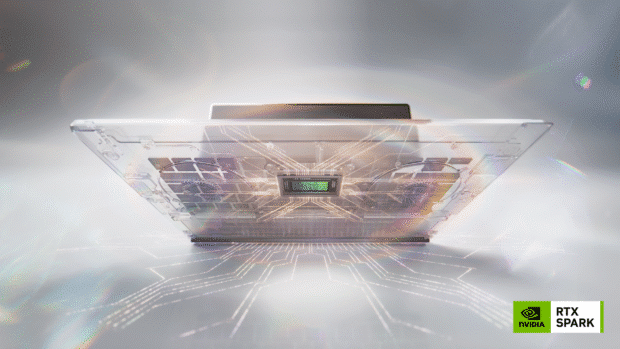
Normally, Windows laptops suffer from a severe identity crisis the moment you yank the charging cable. The system aggressively throttles the GPU to keep the machine from dying in an hour. The RTX Spark, built on a 3nm Arm architecture co-designed with MediaTek, completely rewrites this behavior. It utilizes dynamic power scaling, sipping single-digit wattage when you are just typing out emails or browsing, but scaling up to an 80W ceiling when you load up a heavy render or launch a game. Because of this integration, you get the exact same processing power on battery as you do when connected to a wall outlet.
Under the hood, this minor miracle is driven by a massive architectural shift. Instead of separate components fighting for bandwidth across a motherboard, the 20-core Grace CPU and Blackwell GPU share a unified pool of up to 128GB LPDDR5X RAM. They talk to each other over an NVLink-C2C interconnect at a blistering 300 GB/s.
For digital creators, the physical translation of this technical jargon is spectacular. It means you can load massive 90GB+ 3D scenes on a machine thin enough to slip into a backpack without triggering a system crash. The built-in media engine natively decodes 12K raw video on the go, while the 6,144 Blackwell CUDA cores push AAA games past 100 FPS at 1440p resolution with DLSS 4.5.
Then there is the local AI capability. While the industry has spent the last year hyping up “AI PCs” that mostly just send your data to the cloud, the Spark brings a massive 1-Petaflop compute engine directly onto your lap. It can run a 120-billion parameter Large Language Model locally, keeping your work completely offline. Your data remains yours, automatically scrubbed by NVIDIA OpenShell before any hybrid cloud interaction can even attempt to compromise your privacy.
This is a masterfully engineered package, but let’s be brutally honest about who this isn’t for. If your daily workflow consists of Google Sheets, basic word processing, and casual streaming, buying an RTX Spark laptop is like buying a supercar to drive through bumper-to-bumper traffic on EDSA. It is expensive, highly specialized, and complete overkill for the average user.
But if your livelihood depends on rendering heavy files, compiling code, or gaming without carrying a three-kilogram brick of a power adapter, this is a Best-in-Slot upgrade. It changes your physical relationship with your workspace, freeing you from the outlet hunt for good.
Engineered to be as slim as 14 millimeters and as light as 3 pounds, RTX Spark laptops will be available in 14 to 16-inch sizes, and feature precision-machined aluminum chassis that blends durability with a clean, modern design. Color-accurate tandem OLED displays with NVIDIA G-SYNC technology provide stunning visuals for creative work and immersive gaming.
Small, ultra-efficient RTX Spark desktops are built for agents, creative workloads, gaming and everyday productivity. Major hardware makers are rallying around RTX Spark with many designs already in development.
RTX Spark laptops and compact desktops will be available this fall from leading manufacturers including ASUS, Dell, HP, Lenovo, Microsoft Surface and MSI, with models from Acer and GIGABYTE to follow.


