





Iraqi officials venture into world of the Internet
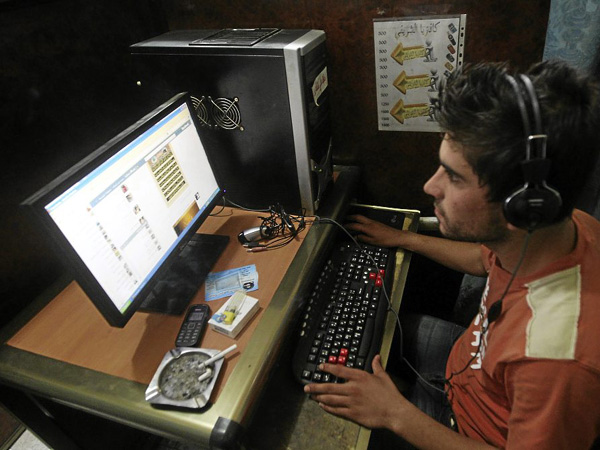
An Iraqi man uses a computer at an Internet cafe in Baghdad on June 26, 2012. AFP
BAGHDAD – Smiling shyly, Wassan Saleh admitted to being the face of a vast problem across Iraq’s bureaucracy that officials are now trying to remedy: she had never used a computer.
Her participation in information technology (IT) classes at a Baghdad college is part of efforts by university professors to help modernize Iraq’s civil service.
The system routinely frustrates — to put it mildly — Iraqis, with its Byzantine rules and paper-based system that has remained largely unchanged for decades.
“This is the first time in my life that I am using a computer,” said Saleh, an official in the commerce ministry, as her introductory class at Baghdad Technical College drew to an end.
“I have a computer at my home, but I had no idea how it worked,” said the 35-year-old. “Now, I will use everything I have learned. It’s really a great experience that I can pass on to my family and my neighbors.”
Internet penetration in Iraq is by far the lowest in the region — it was just 1.1 percent in 2010, according to the International Telecommunication Union.
While mobile phone usage has skyrocketed since the 2003 invasion that ousted Saddam Hussein, use of computers has not expanded at nearly the same rate.
With that in mind, the IT classes for civil servants are designed to be simple.
There is no jargon, no cryptic technical language, and initial lessons are devoted to basic operations and use of simple programs such as Microsoft’s Word or Excel software.
Shortly afterwards, students are introduced to the Internet, and different social media services such as Twitter and Facebook, which have been added in recent years as mandatory courses that students at the college must take.
The lessons are the brainchild of Harith Fuad Jawad, the head of the college’s IT department. He started them in December 2008 after reading a newspaper article that lamented Iraqis’ “technological illiteracy”.
In the article, an unnamed professor recalled how, when teaching students to use computers, “I asked them to drag the mouse up — one of them grabbed the mouse and held it up in the air, over the computer.”
The students take lessons for three hours a day over a 10-day period in a small room with 30 computers. Government ministries decide who to send and the courses are relatively cheap, even by Iraqi standards — just 50,000 dinars ($42, 34 euros), paid for by the government.
“We learned to use several programs like Word and Excel, and we went on the Internet,” said Abdul Jalil Hanoun, a 55-year-old civil servant in the justice ministry.
“We learned things we did not even know existed.”
Lagging behind with technology
The lack of advancement in Iraq in the field of computers comes as a direct result of 30 years of war and sanctions: the 1980-88 Iran-Iraq War; Saddam’s 1990 invasion of Kuwait and the international response the following year, along with the resulting economic embargo; and the 2003 invasion.
“Until 1980, Iraq was the most advanced country in the Middle East when it came to technology,” Jawad complained. “But the war with Iran changed all that, and today, in the technology race, we are lagging far behind.”
Saddam’s regime clamped down on freedom of expression, which extended to use of the Internet, but while the shackles on Iraqis’ use of the web were lifted in 2003, the government has not promoted the use of computers.
Iraqis seeking to get things done at ministries face immense amounts of paperwork, with no option to do any of their work online.
US soldiers, who were stationed in Iraq from the invasion until their withdrawal in December, were often surprised to learn that orders from town police chiefs could take days to get to individual police stations because they were not conveyed by e-mail, but by paper.
At home, meanwhile, Internet subscriptions remain expensive, ranging between $60 and $100 per month, and connection speeds trail behind the rest of the region, let alone the rest of the world.
The course at Baghdad Technical College, however, has made small inroads into that lack of digitisation,
In the first five months of this year, 547 mandarins took their first steps in computer science, according to figures provided by the college.
Other Baghdad colleges have since started similar programmes.
Najwa Abdulridha, 27, proudly declared that she had now learned to send e-mails, after recently completing a course.
“These computers have reduced the planet to a village, and we want to live in this village,” she said.


