





Ask Jeeves shuts down, ending early conversational search


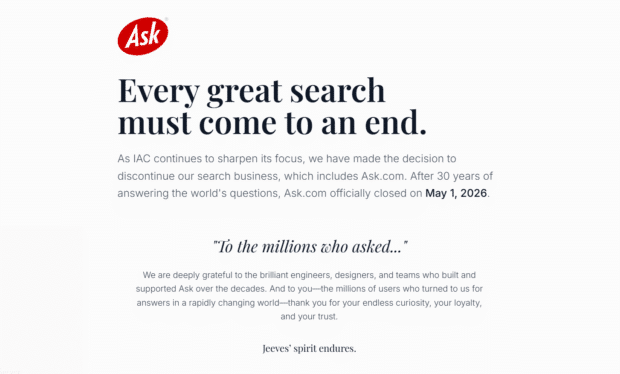
MANILA, Philippines — Ask Jeeves, an early search engine that allowed users to ask questions in plain language, shut down on May 1, marking the end of a conversational search model that has reappeared in today’s AI-powered tools.
Originally launched in 1997, Ask Jeeves allowed users to ask questions in plain language instead of relying on keyword-based search.
The platform used a “butler” persona named Jeeves to guide users and deliver answers based on curated and human-reviewed information.
At a time when most search engines required technical inputs, the service focused on making information more accessible to everyday users.
Its system combined early natural language processing with a database of pre-verified questions and answers.
If no direct match was found, the platform redirected users to related queries or external search results instead of generating uncertain answers.
This approach helped reduce the risk of incorrect information but limited its ability to scale as the internet rapidly expanded.
The rise of automated search engines, particularly Google, eventually overtook the platform due to faster and broader results.
Ask Jeeves was later rebranded as Ask.com in 2006, removing its defining “butler” identity as it shifted toward a more conventional search model.
When search meant asking Jeeves
The emergence of AI tools such as ChatGPT and Gemini has renewed interest in conversational search, a concept Ask Jeeves introduced decades earlier.
These platforms allow users to ask complex questions and receive direct responses through a chat-based interface.
The approach reflects the original idea behind Ask Jeeves, which aimed to make searching feel more like a guided interaction.
However, modern AI systems generate answers using patterns from large datasets rather than relying on pre-verified information.
As a result, responses may sometimes include errors or unsupported claims despite being presented with confidence.
In contrast, Ask Jeeves was designed to provide answers only when supported by available data or human-reviewed sources.
Search shifts toward AI answers
The shift toward AI-driven search highlights differences in how information is delivered to users.
While current systems prioritize speed and scale, earlier models focused on controlled and verifiable outputs.
Experts note that this trade-off remains a key challenge as AI continues to evolve.
Efforts to improve accuracy include combining AI-generated responses with reliable data sources.
Some approaches, such as retrieval-based systems, aim to reduce errors by grounding responses in existing information.
These methods reflect aspects of how Ask Jeeves handled queries through structured and curated results.
The closure of Ask.com marks the end of a platform that introduced one of the earliest forms of conversational search.
It also highlights how search technology has shifted from human-guided systems to automated AI models.
While newer tools offer faster and broader responses, questions remain about reliability and transparency.
The earlier model introduced by Ask Jeeves continues to be referenced in discussions on how AI systems can deliver more accurate and trustworthy information. (By Rojelyn Cona, INQUIRER.net Intern)


