





Virtual reality game brings players back to martial law era


MANILA, Philippines — The martial law years, an era more than half a century ago, still casts its shadow on today’s political scene. But the youth may no longer be that familiar with what survivors of that period call the darkest in the country’s modern history.
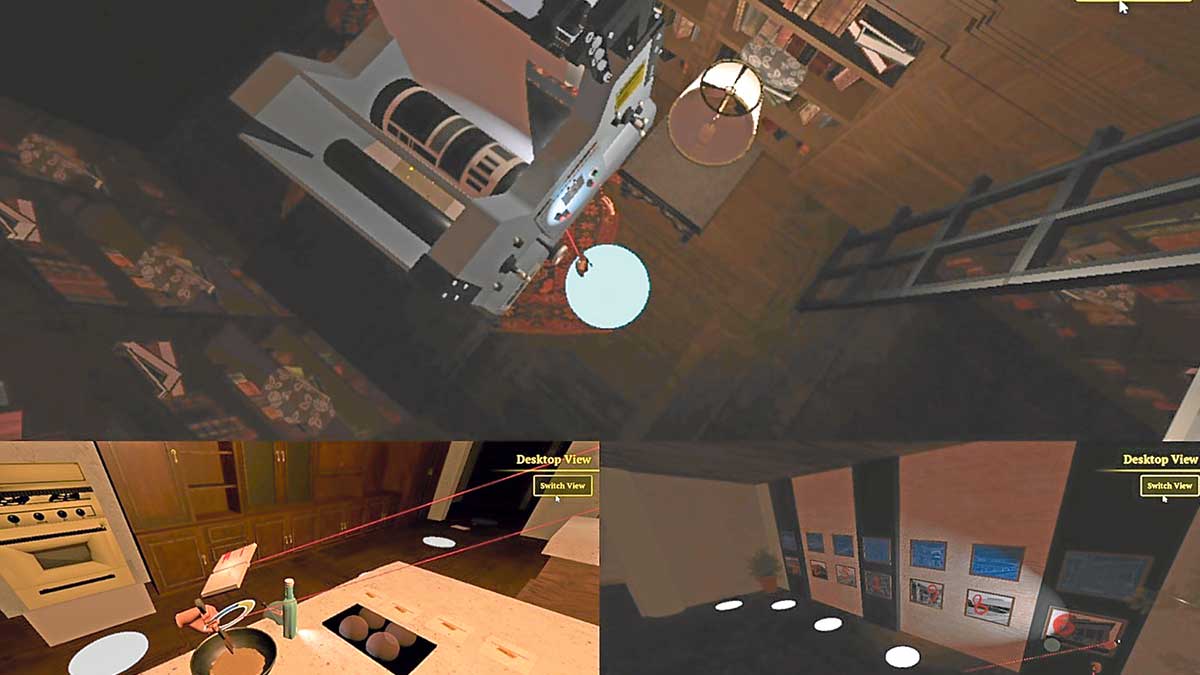
To help acquaint the youth today with the martial law era, Ateneo de Manila University has developed a virtual reality (VR) “escape room” where players can experience that time.
In that game, called “Heritage Hero: Secrets of the ‘Golden Era,’” players navigate through a mansion where they can operate a confiscated printing press, bake a “Nutribun” bread in a virtual kitchen, and uncover various controversies about government corruption.
READ: UP team creates VR games as rehab aid for dementia, cerebral palsy
Developed by the Ateneo Virtual, Augmented and Mixed Reality (VAMR) Laboratory, the VR game has no linear narrative and no moderator to assist the players, who are left to themselves to solve its puzzles—much like the public during that time who were then blind to martial law’s unreported episodes.
The VR game can be requested from the Ateneo Martial Law Museum and Library through its website martiallawmuseum.ph.
READ: SM City Cebu launches XP Arena VR sports experience
‘Golden era’ misinformation
Eric Cesar Vidal, technical head of VAMR, said Ateneo students had tried out the game in a “booth setup” during last year’s commemoration of martial law on Sept. 21. Martial law was actually declared on Sept. 23, 1972, but antedated to Sept. 21.
Previous studies have shown that students learning about “serious” historical topics understand them better when placed in an immersive virtual environment, he said.
“One thing that virtual reality can do is to actually place you in that situation but, at the same time, it’s not going to be in a way that’s going to be threatening to the safety of the person,” Vidal told the Inquirer in an interview.
He said the game is intended to evoke empathy among the players toward people affected by martial law.
“We also mentioned that there were assassinations that happened, but apart from just telling it outright, we wanted to immerse the player into the time period. It feels as if you were learning the facts at the time,” he said.
Specific narratives selected for that game are intended to confront, in a “more nuanced” approach, the misinformation about that time being a “golden era” for the country, Vidal said.
Missing facet
In the section about Nutribun, for example, players learn that this nutrition program was actually adopted by the regime of Ferdinand Marcos Sr. from the US Agency for International Development which originally implemented it.
“Those little things about the history of martial law, we just wanted to set things straight in general,” Vidal said.
There is one facet about martial law that is crucially missing in the game—the rampant cases of torture, disappearances and other human rights violations at that time.
To many Filipinos, that collective experience is what truly defines that era.
But according to Vidal, there were difficulties in incorporating human rights abuses into the game design without affecting the players’ well-being.
“We didn’t want the player to get too uncomfortable and nauseous during gameplay [by] showing them scenes of torture, even more so from a first person perspective,” he said, adding that it was “a bit problematic” to include that part of martial law history in “an immersive game targeting younger adults.”
He said the game sought instead to portray the actual economic conditions during martial law and how these affected Filipinos at that time.
But political conditions were somehow still referenced where possible, Vidal said.
He cited, for example, the 1980 assassination of tribal leader Macli-ing Dulag following his opposition to the proposed Chico River hydroelectric dam. The project was eventually aborted because of resistance by his community.
‘What really transpired’
Vidal said the game is not meant to encourage players to “take sides” but to merely present what happened during that time.
“When we talk about the economic development, all of the new buildings that were built by the Marcoses, we acknowledge that these actually did have an impact in terms of the economic stature of the Philippines during that time. But it’s not without its flaws,” he said.
“For example, when they built the Manila Film Center [for the 1982 Manila International Film Festival], there was a disaster that happened,” he said, recalling the rushed construction of the building at the CCP complex which led to the collapse of a floor that buried construction workers in wet cement.
“We just want the players to learn about these micro-aspects, …so that the player comes out with a more nuanced idea of what really transpired during the martial law period,” Vidal said.
Underrepresented subject
Alvaro Pato, the game’s lead developer, said the Ateneo Martial Law Museum and Library helped ensure its historical accuracy and provided videos and images as references.
“The printing machine they provided [is] a period-accurate model that we could create a version of,” Pato said. “The setting itself, the house, we had to make it [in the style of] ’80s Filipino homes. What architecture was popular in the ’80s for wealthy Filipinos? A lot of those [details we sought] for period accuracy.”
Vidal said they also purchased an actual “flashlight radio” that was popular at the time so they could make a 3D model out of it. Players get to crank the radio, which Vidal said was meant to replicate the experience of using that apparatus amid the frequent blackouts during that “golden era.”
He said VR games have the potential to help educate students about subject matters that are now underrepresented, such as the martial law years.
He noted that there are many VR games now about the STEM subjects of science, technology, engineering and mathematics, but few so far about history.
“We wanted to expand specifically on that niche, and there’s also the fact that we wanted to tackle anything that has a unique Philippine flavor to it,” Vidal said.
‘Infancy period’
VAMR has already created other historical games, including the first installment of the Heritage Hero series about the Villa Escudero Museum in Tiaong, Quezon.
Among their other projects is a VR game that teaches students about Attention Deficit Hyperactivity Disorder by simulating the day-to-day life of a person with that condition.
“Right now, there’s a lot of research [on] educational games using virtual reality,” Vidal said. But he noted that the commercial industry for such VR games is still in its “infancy period.”
“We don’t know a lot of people who are actually making those games right now, even in the Philippine context,” he said. “So we want to promote that because we do believe that this particular modality, virtual reality, could be an edge for Filipino game developers who want to carve a niche in the already crowded space of gaming.” /cb


