CoMaps, my favorite OpenStreetMap-based mobile app, is now one year old! This Google Maps alternative first became available on Google Play and the Apple App Store on July 3, 2025.
What exactly is CoMaps? It is a free and offline map and navigation mobile app that is community-driven and privacy-first. The offline feature works by first downloading your regions of interest before using the app. For example, downloading all of the data for the Philippines requires 610 MB of storage.
The app provides many of the features that you would expect from a navigation app, including feature search, turn-by-turn directions (with driving, walking, cycling, and public transport modes), favorite lists (with import and export), GPS track recording, and elevation data. The only major features missing—and these are due to cost—are satellite imagery, 360° street-level photographs, and real-time traffic data.
Article continues after this advertisement
I have been using this CoMaps since it first became available and it proved useful (and is a nice complement to Google Maps) when I attended a conference in Taiwan last May.
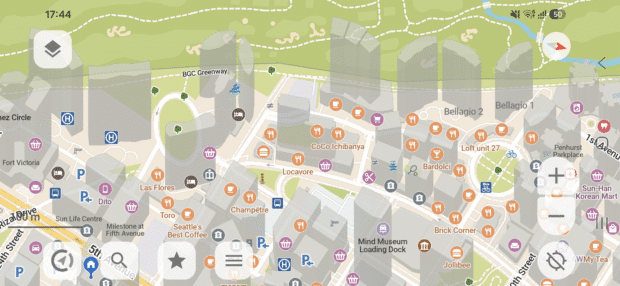
Screenshot of CoMaps showing 3D building outlines in the Bonifacio Global City area.
Privacy as the north star
Unlike Google Maps, which by default records your movements and stores your whereabouts, CoMaps promises never to track you. If you view the app’s privacy policy, it only contains three sentences!
At CoMaps, we respect your privacy. CoMaps does not have any form of identification of people, advertising, or personal data collection.CoMaps does not track you.
This is in stark contrast to Google’s privacy policy, which is comparatively a nightmare to read and navigate. (Google doesn’t have a specific privacy policy for their Maps app.)
And if you browse through the “data collected” section of Google Maps on Google Play, it collects a plethora of information: location, personal info, device or other IDs, contacts, app info and performance, web browsing, financial info, photos and videos, files and docs, messages, app activity, and audio. Whew!
Looking at CoMaps’ corresponding section, it proudly declares “no data collected”. Plus, there are no ads!
Open map data via OpenStreetMap
CoMaps manages to be free mainly because it uses OpenStreetMap (OSM) as its primary map data. If you are not familiar with OSM, you can think of it like this: OSM is to atlases what Wikipedia is to encyclopedias. Basically, OSM is the map that anybody can edit, and over 10 million (mostly volunteer) mappers have contributed ~10 billion map points and ~1.2 billion lines/shapes to the database.
Article continues after this advertisement
In its over two decades of existence, OpenStreetMap has become the largest freely available global map database. It has become so big and valuable that four of the six biggest tech companies—Apple, Meta/Facebook, Amazon, and Microsoft—all make use of OSM, and some even contribute labor or resources to support the project. In Southeast Asia, Grab is a huge supporter and uses OSM to power many aspects of its mobile app.
Aside from OSM, CoMaps also makes extensive use of Wikipedia by providing an offline copy of the text of Wikipedia articles for nearly every place on the map. So you can use the app as a sort of travel guidebook.
Two screenshots of CoMaps showing a copy of the Wikipedia article for Intramuros’s Plaza Moriones on the left, and the details for the one-Michelin-starred restaurant Toyo Eatery on the right.
Open source and the right to fork
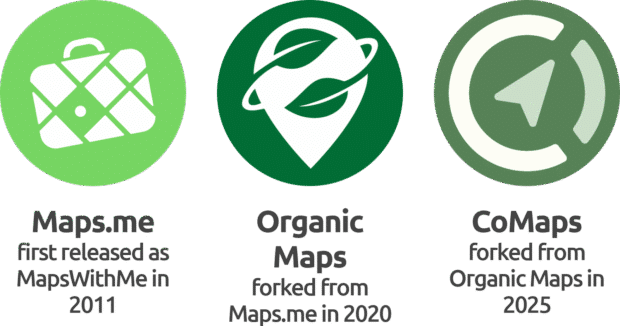
When I say that I have been using CoMaps for a year now, that isn’t exactly accurate. This is because CoMaps is actually a fork of the Organic Maps mobile app, which itself was forked from the much earlier Maps.me app. I have been a user of Maps.me, then switched to Organic Maps when it was released, and finally jumped to CoMaps.
This forking story is pretty wild. In 2011, MapsWithMe was created by a group of Belarusian developers who aimed to provide a free offline navigation mobile app using OpenStreetMap data, alongside a paid “pro” version with extra features. Their company was acquired by Mail.ru, a Russian tech company (that later became social media giant VK), in 2014, and the app was renamed to Maps.me. Crucially, the free version of Maps.me was released as an open-source project in 2015 under the Apache 2.0 license.
In 2020, Mail.ru sold off Maps.me to Daegu Limited, part of the fintech Parity.com group. The new owners released an update that had a different UI and incorporated mobile wallet features. This resulted in backlash among a portion of the app’s users, who had been bothered by the increasing commercialization of the free app.
Fortunately, Maps.me was open source, and so the right to fork the project existed. Through the effort of some community members and a couple of the original Maps.me developers, Organic Maps was founded in December 2020, and they released the first version of the app on Google Play in June 2021.
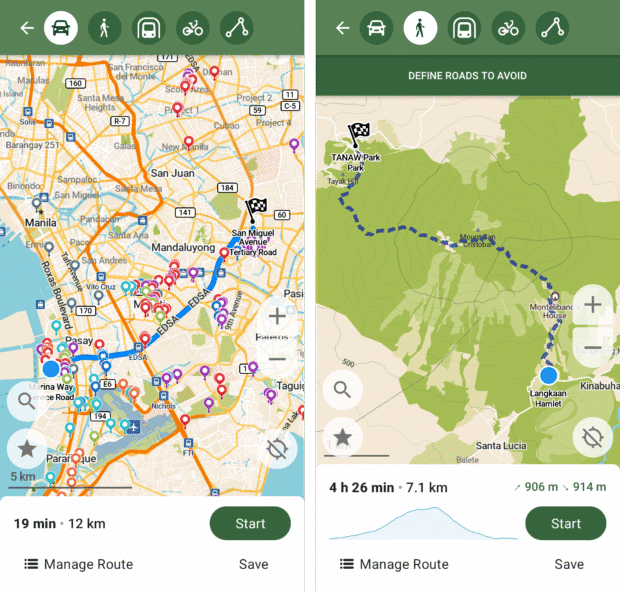
Two screenshots of CoMaps showing driving directions from Pasay to Ortigas Center on the left, and a hiking traverse of Mount San Cristobal in Quezon and Laguna provinces on the right, showing the trail’s elevation profile.
In the grand tradition of other popular open-source projects, the people behind Organic Maps sought to have development be community-based and not controlled by any commercial entity. Furthermore, they pivoted to a privacy-focused approach and removed all tracking software from the original source code.
Sadly, trouble began brewing in 2025 when community members began voicing issues regarding the project’s governance and transparency, and what seemed to be profit-driven motives of its leaders. (Organic Maps OÜ, the project’s company, was originally registered as a for-profit LLC in Estonia.) This culminated in a group of users publishing an open letter in April 2025 threatening to fork the project if concerns weren’t addressed.
Well, the problems were not resolved to the community’s satisfaction, and Organic Maps was forked yet again, giving birth to CoMaps. This time, the forkers added an explicit not-for-profit mission in addition to the existing privacy-first approach.
Third time’s the charm?
This saga of people forking open-source projects because of disgruntlement is not unique to CoMaps. One particularly famous example is the forking of the open-source office suite LibreOffice from OpenOffice following community misgivings after Oracle acquired Sun Microsystems, the owner of OpenOffice. (Oracle eventually donated OpenOffice to the Apache Foundation, thereby becoming Apache OpenOffice.)
Will CoMaps suffer the same fate as its predecessors? Given that CoMaps is now explicitly not-for-profit, I hope it lasts.
The beauty of open source is that we don’t have to worry about bad governance creeping up in the future. The real innovation of the free and open-source software movement is not that anyone can read the source code; it is that no person or corporation can hold a successful software project hostage. CoMaps is yet another example that good governance is every bit as important as good code.
Your subscription could not be saved. Please try again.
Your subscription could not be saved. Please try again.
Your subscription has been successful.
Disclaimer: Comments do not represent the views of INQUIRER.net. We reserve the right to exclude comments which are inconsistent with our editorial standards. FULL DISCLAIMER