


What The Oregon Trail & Kerbal Space Program teach about failure


MANILA, Philippines — A player in The Oregon Trail faces a high-stakes choice at a swollen river: ford the water, pay for a ferry, or risk losing supplies. Miles away from 19th-century pioneers, Kerbal Space Program presents a similar dilemma, as a player watches their carefully built rocket tip sideways and disintegrate on launch
These failures stem from simple miscalculations, a risky river crossing or a flawed launch design. Yet a mistake is rarely just a “game over.” It is feedback: players see what failed, adjust their approach, and try again.
Can failing in a video game teach us how to handle setbacks in real life?
Why we learn by playing
Games turn decisions into experiences. Instead of only reading about a problem, players must respond to it: make a choice, see the result, and adjust their approach.
The Oregon Trail and Kerbal Space Program offer two clear ways to see that process. One turns limited supplies and uncertain conditions into difficult choices; the other turns a failed rocket launch into a design problem to solve.
Research suggests this cycle can support learning. In a study of 88 middle-school students playing Virulent, an educational game about virology, researchers found that students who failed more often before succeeding at a level showed greater learning gains. Failure also prompted students to discuss the game’s content and mechanics with classmates.
This helps explain why games have found a place in education. Some use gamification, adding points, badges, and rewards to non-game activities, while others use game-based learning, where the game’s rules, challenges, and decisions become the learning environment itself.
A streak may encourage someone to practise a language every day, but keeping the streak does not necessarily mean they understand the language. In a game built around problem-solving, players need to understand why a strategy works or fails.
Still, participation is not the same as understanding. Players can repeat a winning strategy without knowing why it works, or succeed by chance. The challenge is designing games that make the consequences of a decision clear enough for players to learn from them.
RELATED STORY: 13-year-old finishes 25th out of 187 in global Tekken tournament
The Oregon Trail: Learning from every wrong turn
The Oregon Trail began in 1971 as a classroom history game created by three student teachers at Carleton College in Minnesota: Don Rawitsch, Bill Heinemann, and Paul Dillenberger.
Rawitsch had designed a board game about westward migration. Heinemann and Dillenberger suggested turning it into a computer game, which the group programmed in BASIC. Students first played it through a teletype machine on December 3, 1971.
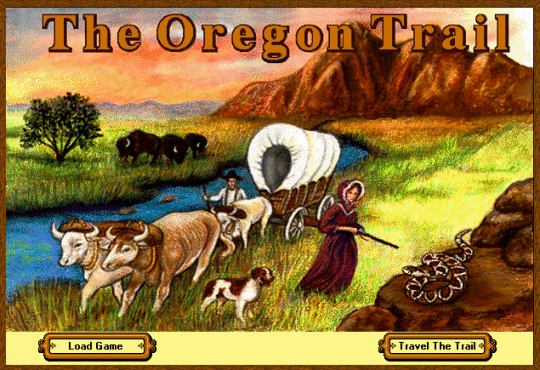
Rawitsch later deleted the program, but revived it after joining the Minnesota Educational Computing Consortium (MECC) in 1974. The game eventually became one of the organization’s best-known educational titles. Smithsonian Magazine
In the game, players lead a party along the roughly 2,170-mile route from Independence, Missouri, to Oregon’s Willamette Valley. Starting with limited money, they must decide how to spend it on food, clothing, oxen, ammunition, and spare parts.
Every choice carries a cost. A faster pace may save time but exhaust the travelers. Overspending early can leave the party short of supplies later. A river crossing can turn a routine journey into a disaster.
The game makes planning important because consequences do not always appear immediately. Players must think beyond the next screen and consider how today’s decision will shape the rest of the journey.
But the lessons The Oregon Trail teaches depend on the history it chooses to tell.
Indigenous people appear mainly as guides or traders, with little attention to their lives or perspectives. Critics, including Rethinking Schools curriculum editor Bill Bigelow, have argued that this framing gives players an incomplete picture of westward expansion.
Rawitsch has also reflected on how the game might be made differently today, including through a version told from a Native American perspective. A later Gameloft remake for Apple Arcade took a step in that direction, introducing playable Native American characters and drawing on input from three Native American historians.
These versions show that educational games do more than present information. Their design determines whose experiences players encounter and which parts of history remain outside the frame.
The Oregon Trail can teach resource management and the weight of difficult choices. But learning from it also means asking what its version of history leaves out.
Kerbal Space Program: When a rocket crash becomes a lesson
Where The Oregon Trail puts players in charge of a journey, Kerbal Space Program gives them control over the machines that make it possible.
Developed by Mexico-based studio Squad, the game first became publicly available in June 2011. Players build spacecraft from engines, fuel tanks, and structural parts, then try to launch them into space.
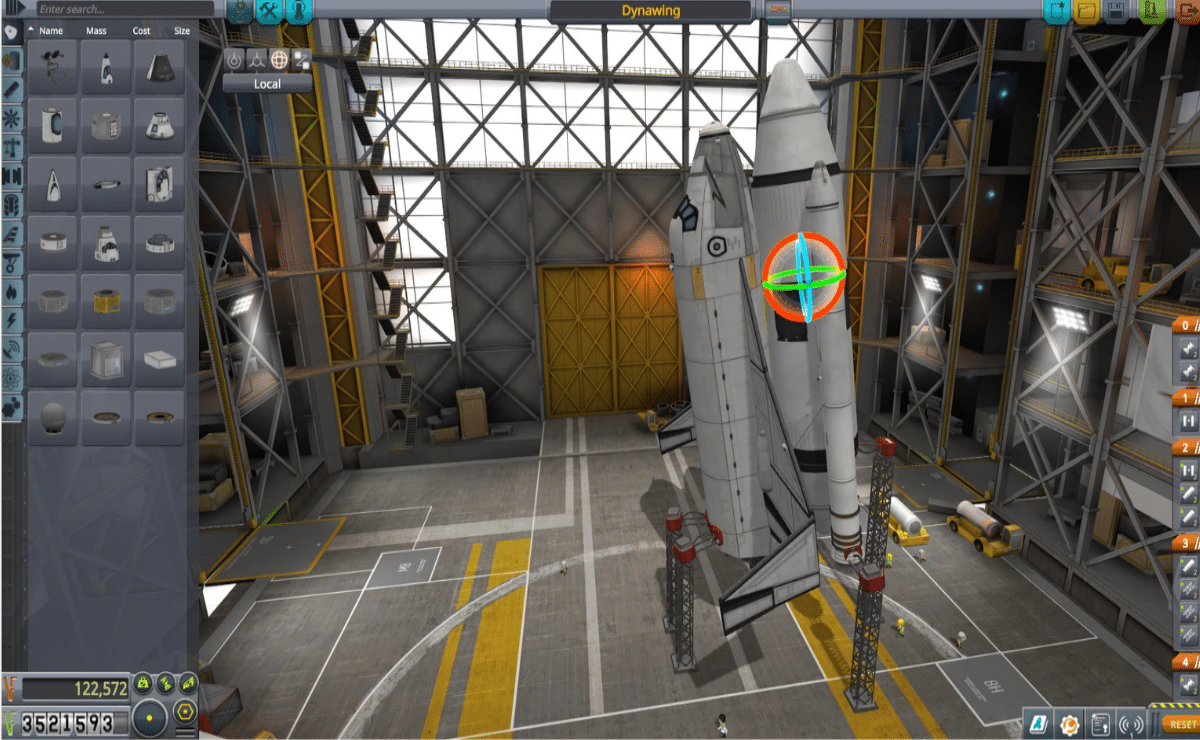
Reaching orbit is not simply a matter of adding parts. A rocket may lack thrust, carry too much weight, run out of fuel, or break apart because its components are poorly arranged.
When a launch fails, players return to the assembly area and revise the design. They might add an engine, reposition a fuel tank, or change the timing of a rocket stage. Each attempt shows how one change affects the outcome.
This makes failure part of the learning process. Rather than reading about thrust or orbital motion and moving on, players test those concepts in a simulated environment.
The game also introduces ideas such as thrust-to-weight ratio, rocket staging, and orbital mechanics. Its science mode rewards experiments with points that unlock new parts, encouraging players to keep testing designs.
That potential has reached classrooms. KerbalEdu, developed with TeacherGaming, added tools for teachers, including a flight recorder that lets students examine data from their attempts.
In fall 2020, Montgomery County Community College in Pennsylvania ran a pilot course called Kerbal Math & Physics Lab. Students used the game to fly spacecraft toward the Moon and apply mathematical concepts, including the vis-viva equation, to examine orbital motion and energy.
A failed launch can push a student to examine the design and calculate what needs to change. But success does not automatically prove understanding. A player might copy a working design or keep changing parts until something works without knowing which adjustment made the difference.
The game creates opportunities to experiment. What players learn still depends on whether they understand what those experiments reveal.
Research suggests digital games can support learning, but the results depend on how they are designed and used.
A 2016 meta-analysis by Douglas Clark, Emily Tanner-Smith, and Stephen Killingsworth examined digital games in education from kindergarten through college. Across 57 comparisons, students who learned with digital games performed better on average than those in nongame conditions, with an average effect size of 0.33.
The findings suggest games can help people learn. They do not guarantee that every game will work, or that playing alone is better than other forms of instruction.
How a game is used matters. Wouters and colleagues found stronger learning outcomes when serious games were combined with other instructional methods, played across multiple sessions, or used in groups.
That matters for games like The Oregon Trail and Kerbal Space Program.
A teacher might ask students to compare The Oregon Trail with historical sources, examining how it represents Indigenous people and westward migration. After a failed rocket launch, students could predict what would happen if they changed an engine or fuel configuration, then compare their predictions with the results.
In both cases, the game becomes a starting point for discussion, not the entire lesson.
The lesson behind the failure.
A stranded wagon and a shattered rocket offer different lessons.
The Oregon Trail asks players to manage scarce resources and weigh decisions whose consequences may emerge much later. Kerbal Space Program lets them experiment with designs and see how changes affect performance.
Both give players room to make mistakes. But the value of those mistakes depends on what happens next.
Restarting a journey does not necessarily deepen a player’s understanding of history. Launching a successful rocket does not necessarily mean someone understands orbital mechanics. Without reflection, failure can become just another obstacle.
Games can make complex ideas easier to explore by turning abstract concepts into decisions and visible consequences. But they also simplify reality and those simplifications shape what players learn, and what they overlook.
The goal is not simply to make failure fun. It is to make failure meaningful.
RELATED STORY: OpEd: The gaming industry braces for an inevitable cultural shift


