





Laguna textile hub turns farm waste into high-value fibers


MANILA, Philippines — The Department of Science and Technology–Philippine Textile Research Institute (DOST-PTRI) launched a Natural Textile Fiber Innovation Hub in Sta. Cruz, Laguna on April 16, aimed at converting agricultural waste into textile materials and supporting local livelihoods.
The facility, located at Laguna University, is the third hub of its kind in the country and focuses on processing fibers from abaca, banana, and pineapple.
It can handle up to 40 kilograms of natural fibers for yarn production, allowing farmers and weavers to take part in higher-value stages of textile production.
DOST-PTRI Director Julius Leaño said the initiative aims to move beyond exporting raw materials toward producing finished or semi-processed goods.
“That is exactly the point of why we are here. We are trying to extend the supply and value chain such that we do not just export raw materials, we export higher-value products,” Leaño said.
He added that Laguna offers an advantage in logistics, noting that its proximity to Metro Manila reduces the carbon footprint compared to fiber sources from more distant regions.
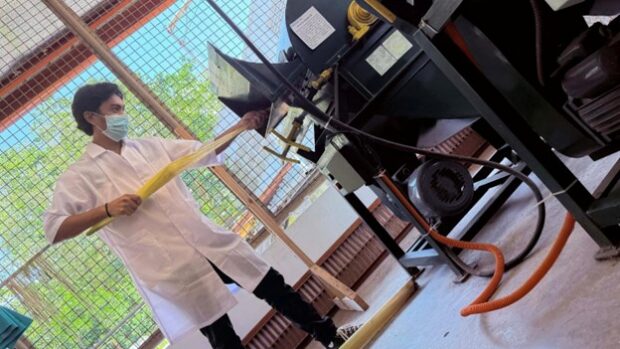
Linking Farmers and Weavers to Textile Production
Science and Technology Secretary Renato U. Solidum Jr. said the hub is expected to create jobs and strengthen the local textile industry by connecting research with community-based production.
The facility is also intended to support micro, small, and medium enterprises (MSMEs), particularly farmers and weavers involved in fiber production.
DOST Undersecretary Sancho A. Mabborang said the project is designed to expand livelihood opportunities and employment.
“We are not only establishing innovation hubs and facilities, but we are also looking into who will benefit from what we are doing,” Mabborang said.
Local officials also expressed support for the initiative and signaled plans to work with academic institutions to develop textile-based products using locally sourced fibers.
Among these is the possible use of natural fibers for academic garments such as the sablay.
Researchers also said water hyacinths from Laguna de Bay are being tested for yarn production, with early results showing potential as an alternative material. (By Rojelyn Cona, INQUIRER.net Intern)
Read the latest on DOST projects:


