





Review: What’s new with the Samsung Galaxy S26 series?


SAN FRANCISCO, California – Samsung has officially announced the 2026 refresh of their flagships – the Galaxy S26 series.
For smartphones, the past few years has seen a lot of yearly incremental upgrades, with most flagship devices being compelling, yet not revolutionary enough for a big upgrade. This year, Samsung wants you to believe otherwise. The new Galaxy S26 series has a few new tricks up its sleeve, beyond the usual AI and speed bump.
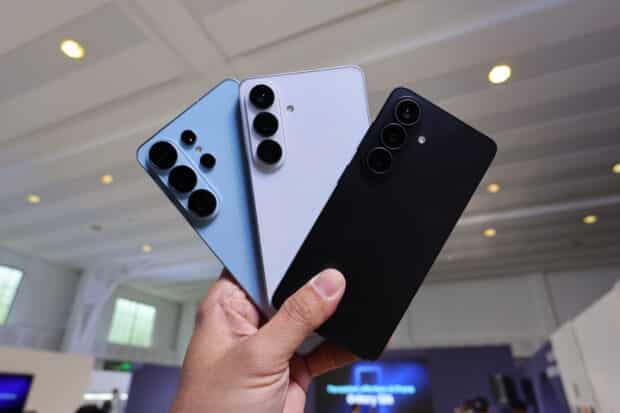
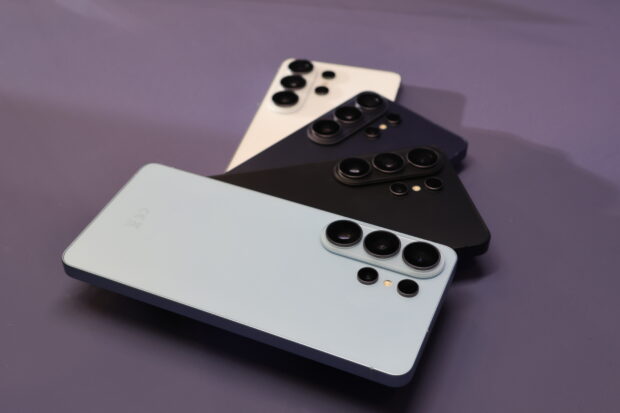
As always, Samsung has kept the three-part spread on its flagship series with the new Galaxy S26, S26+, and S26 Ultra. The colors are clean: Cobalt Violet as the iconic hero shade, White, Black, and Sky Blue, with a couple of online-only colors for people who like their tech to look slightly rarer than it is.
The Ultra still includes the S Pen. It’s made to be bigger, heavier, and quite honestly expects you to live your life in it. The S26+ is the “most people” phone, which is big enough to look premium, but not so big that it starts running your life. The base S26 is the lightest option, made for people who want the unadulterated classic flagship experience.
Performance: Exynos and Snapdragon in the same basket
Samsung’s chipset split is part of the S26 positioning. The Ultra runs Snapdragon 8 Elite Gen 5 for Galaxy on a 3nm process; the S26 and S26+ take the home-grown 2nm Exynos 2600. Even without turning this into a chip-war paragraph, there’s no bias that Samsung is segmenting power the way it segments lifestyle.
Despite the price increase of RAM across the globe, Samsung refuses to compromise memory. Even the base S26 comes with 12GB RAM to deliver a premium experience for handling modern multitasking and on-device AI without any compromise. The Ultra stretches further with a 16GB option, which makes sense for people who treat their phone like a pocket computer.
Typical to the flagship series, there’s no microSD slot across the entire lineup. Samsung is betting you’ll buy the storage up front, and the tiers are wide enough (up to 1TB on the Ultra) that most people won’t need “external upgrades” to make the phone feel complete.
Displays: all go smooth
All three models run that smooth 1–120Hz range, which ensures everything is consistently fluid. The differences show up in the size and sharpness tiers:
→ The Ultra is a 6.9-inch QHD+ panel with S Pen support→ The S26+ sits at 6.7 inches and QHD+→ The base S26 is 6.3 inches and stays FHD+
Most people won’t obsess over FHD+ versus QHD+ the way tech sheets suggest. The base model being smaller and lighter matters more, day after day, than the fact that it isn’t the sharpest panel on paper.
Samsung knows that, and the lineup was clearly designed by someone who might have watched people stop caring about pixel math once a phone feels good in their hands.
The privacy feature everyone will understand
Some privacy features are real but invisible, which makes them hard to value until something bad happens. Samsung’s privacy-forward move here is more visual and instantly legible with the privacy display.
Typically, this was a screen protector you buy from your local cellphone store. Now it’s built in, without compromise to battery life. Privacy display is a screen behavior (meaning it’s software-driven) — pixel-level control that blocks side-angle viewing (or “anti-shoulder-surfing”) and can selectively obscure sensitive parts of the screen while keeping the rest readable. It’s privacy that doesn’t rely on accessories or, again, “external upgrades.”
From AI tools to something closer to a companion
I was lucky enough to experience Samsung’s nod to AI as a companion at First Look at the CES Las Vegas last January and catch a glimpse of what the newest flagship is aiming for – Galaxy AI isn’t meant to be a separate mode you enter.
It’s a layer that understands your intent across the phone, surfacing the right information and prompting your next action without making you do the mental work of asking, “Which app was that in?”
This is where Now Bar and Now Brief start to matter more than branding. The best examples are the ones that don’t appear like AI at all:
→ Circle to Search remains the most adoptable behavior Samsung has helped normalize because it matches how people actually think: see something, circle it, move on. No app switching, no copy/paste gymnastics.
→ Finder goes after a different modern problem when your phone is full of information you technically own but can’t access quickly because it’s scattered across apps and buried under notifications. Finder scans through your apps and notifications to surface what you meant to keep, like a flight itinerary.
→ Bixby can now act as a device agent when your phone is doing something annoying. You simply talk to it the way you’d talk to someone sitting next to you and be like, “Please fix this.” Because you’re not a settings scientist, after all.
Now that other phones have heard about it, can they also stop wasting your time in small, repeated ways?
A myriad of uncluttered AI features
The smartest AI features are usually the ones that sound boring until you realize you do them constantly.
→ Document Scanner uses your camera to minimize distortion and enable multi-scans so you’re not fighting perspective every time you need to digitize a page.
→ Screenshots get the “finally” upgrade with automatic organization that categorizes your supposed “junk drawer.”
→ Galaxy AI Photo Assist helps you reframe, resize with generative AI, fill in backgrounds, and remove objects without an Adobe PS subscription.
They’re not so novel, but they do lower the cost of everyday tasks.
Battery: finally, faster charging
The Ultra sticks to its everything-big identity → a 5,000mAh battery, Super Fast Charging 3.0, and the full wireless suite. The S26+ sits just behind at 4,900mAh, nearly Ultra stamina without Ultra bulk. The base S26 lands at 4,300mAh, still respectable, but clearly designed around being the lighter, more pocket-friendly flagship.
Wireless PowerShare also remains across the lineup, which lets you connect to your other Qi-certified devices, such as Galaxy buds, watch, or other phones. Seems pointless until you’re seated at a nearby Starbucks with no power outlets and a report is due in a few hours.
Cameras: refining what the S25 already got right
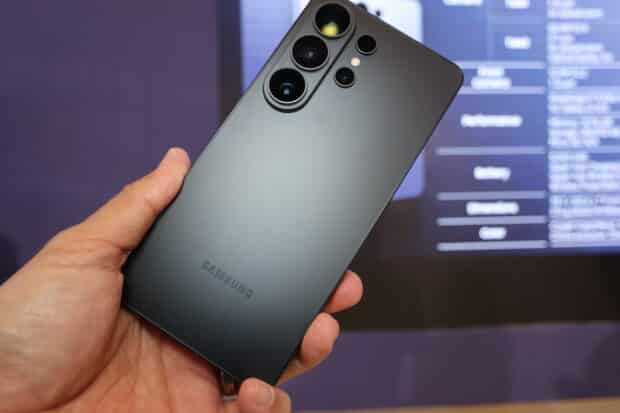
With the S26 Ultra, Samsung isn’t pretending to rewrite its own formula. The big shapes stay the same: a 200MP main camera, a 50MP ultra-wide, a zoom setup built around 3x and 5x, and a front camera at 12MP f/2.2, 1.12μm.
The difference is in the tuning, especially on paper, where the main camera’s wider aperture and the longer zoom lens’ specs suggest Samsung is trying to make everyday frames cleaner before any AI “fixing” even starts.
The S26+ stays the practical one. It keeps the rear trio most people use without turning zoom into the whole personality of the phone.
Pricing and context with the ‘AI tax’
In the Philippines, SRP shown at launch puts the base S26 at ₱58,990 (256GB) and ₱72,990 (512GB). The S26+ goes ₱74,990 (256GB) and ₱88,990 (512GB). The Ultra climbs to ₱86,990 (256GB), ₱100,990 (512GB), and ₱121,990 (1TB).
If you bought last year’s S25 series, the jump looks familiar. The S25 Ultra started at ₱84,990 (256GB), ₱93,990 (512GB), and ₱110,990 (1TB), while the standard S25 started at ₱51,990 (256GB).
So yes: the S26 costs more at roughly 10% price increase across the board compared to its previous series. The practical counterargument is that memory pricing and AI-era component demand have been volatile. RAM is no longer the cheap background part it used to be, and phones pushing more on-device AI need more of it. This price increase may sound dramatic but it’s a common narrative we are seeing in the entire tech industry.
Who is this for?
If you’re upgrading from an older Galaxy or another Android smartphone, the S26 lineup does make sense because of fast-charging alone. Remember that Samsung has been playing around with a 60W charger so this bump in charging time is the most practical hardware addition yet, putting it at par with many other C-brand phones. But software features such as AI call screening and the privacy display are also quite enthralling to have.
If it is a matter of price, the displayed SRP can get lower with trade in and other voucher promotions as Samsung has always been generous with the preorder voucher hunting, some even bringing the price down by half!


