





Diving deep into an earthquake Wikipedia article


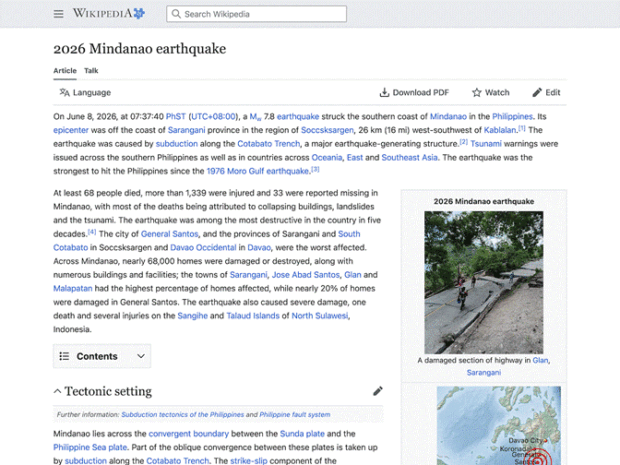
At 7:37 a.m. of June 8, a 7.8-magnitude earthquake struck off the coast of Sarangani province.
Ten minutes later, a Wikipedia editor with the username Dora the Axe-plorer created a Wikipedia article titled “2026 Mindanao earthquake” with just the following single sentence: “A major earthquake struck Mindanao.”
It has been over a week since the tremor occurred, and the article has now been edited over 870 times by nearly 150 user accounts. It now exceeds 10,000 words long and occupies almost 110 kilobytes of raw wiki text. Those thousands of words are referenced from 179 sources, including reports from Phivolcs and the United States Geological Survey, local news articles from INQUIRER.net and the Philippine News Agency, and international media like The Straits Times, Associated Press, and BBC News.
As of the time of writing, the article has been viewed over 145,000 times, and 27 other Wikipedia language editions have their own articles including Hindi, Japanese, Russian, and Dutch.
Breaking news, Wikipedia style
Wikipedia is well known for quickly covering breaking news. And there is often a race to edit biographies of recently deceased to add the person’s date of death and change “is” to “was.” The earthquake article is no different, with Wikipedians quickly developing it as news reports came in.
Thanks to widely accessible tools like GlobalQuake and Early-est, Dora the Axe-plorer was able to access processed data from global seismic monitoring networks and saw that a major earthquake occurred in the Philippines. So they created the Wikipedia article just 10 minutes later, ahead of official sources like Phivolcs and the United States Geological Survey.
Wikipedia’s real strength is not speed but synthesis. While news organizations report individual developments, Wikipedia’s users work to assemble a coherent narrative from dozens or hundreds of sources.
The journey to the main page
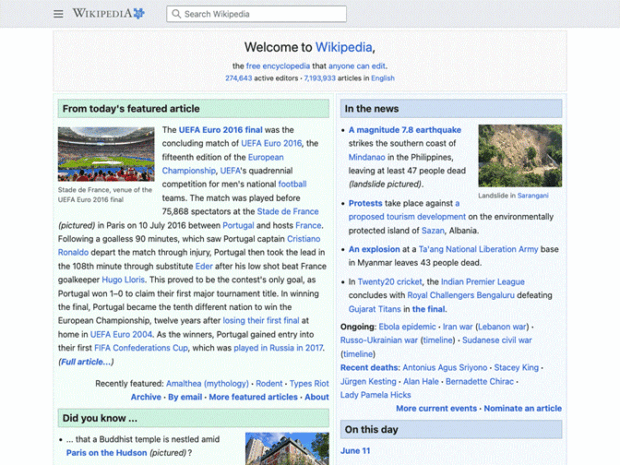
Main page of Wikipedia on June 11, with the Mindanao earthquake listed at the top of the “In the news” section.
If you have ever seen the main page of Wikipedia, you might have noticed the “In the news” section providing an overview of the major events happening around the world. What you may not know is that there is a somewhat complex editorial process for selecting which news to feature because there is limited real estate on the main page.
When you follow the “Nominate an article” link at the bottom of the section, you get a glimpse of how this process goes. Basically, any Wikipedian can propose that a (usually) new or existing article covering a recent event be linked from the Main page. Other people discuss the merits, and if there’s a rough consensus, the article gets selected with a chosen blurb.
In the case of the Mindanao earthquake article, Wikipedian Bloxzge 025 proposed the article for “In the news” just two hours after the earthquake started. Despite being the globally strongest earthquake in 2026 so far, and it being the strongest in the Philippines since the devastating 1976 Moro Gulf earthquake, the initial discussion centered on the relatively low casualty count at that time and the fact that other recent stronger earthquakes weren’t similarly featured.
By late night of June 8, however, the reported number of people killed had climbed to the 30s, pushing the quake’s impact further. This persuaded several Wikipedians to support its mention on the main page with Maplestrip saying, “Wow! This article was put together fast. Looks good and thorough, great blurb.”
The article was finally added to Wikipedia’s front page a little over 24 hours after it was created.
Rapid growth, then refinement
Because Wikipedia stores every edit made to its articles (except for some redacted versions due to legal reasons), anyone can see how the sausage is made, so to speak. You can inspect past versions of the article, and even compare differences between revisions.
Wikipedians have a lot of experience writing articles about earthquakes. Thus, it’s quite easy to structure the article by discussing the geology of the event—including its tectonic setting and reports of tsunamis and aftershocks—the impact the tremor has had on people and buildings, and finally the response, relief, and reactions from the government and civil society. It’s just a matter of filling in the details as news reports come in.
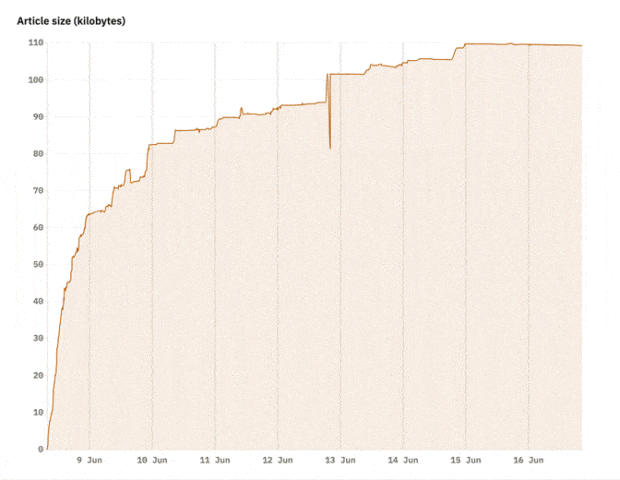
Using Wikipedia’s API (application programming interface), we can query the edit history and extract statistics. Shown below is the growth of the article in bytes.
And here is the chart showing the increase in the number of references cited in the article.
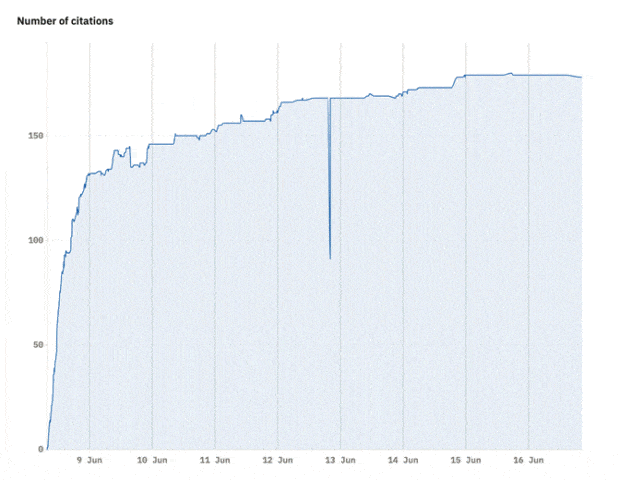
You may be wondering what that weird downward spike was late on June 12. Well, a non-logged-in user completely replaced the article with the text from the “Earthquake” article. This was quickly reversed.
Finally, here is a bar chart of editing activity on an hourly basis.
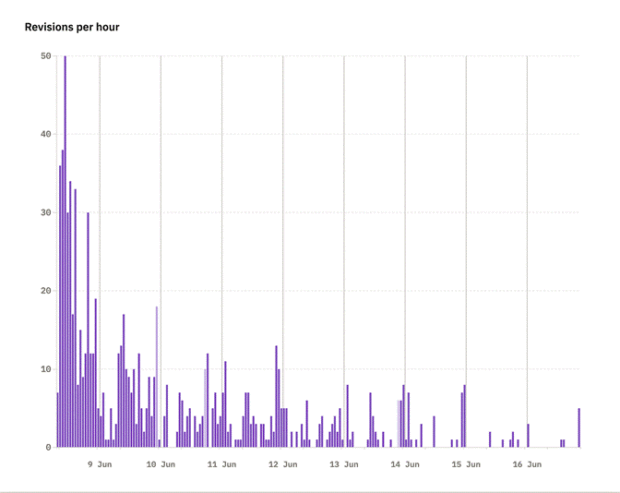
Evident in these charts is the very rapid increase in the article’s size and scope during the first 24 hours as Wikipedians worked to consolidate the disparate and sometimes conflicting information from experts and reports on the ground. (Was it an 8.1 magnitude quake? No, it’s actually 7.8.)
From the second or third day onwards, you could say that the article entered its refinement phase, where details are added and updated, text gets copyedited, and new information is inserted.
Eventually the editing will slow down and the article will become another permanent record in Wikipedia’s coverage of Philippine history.


